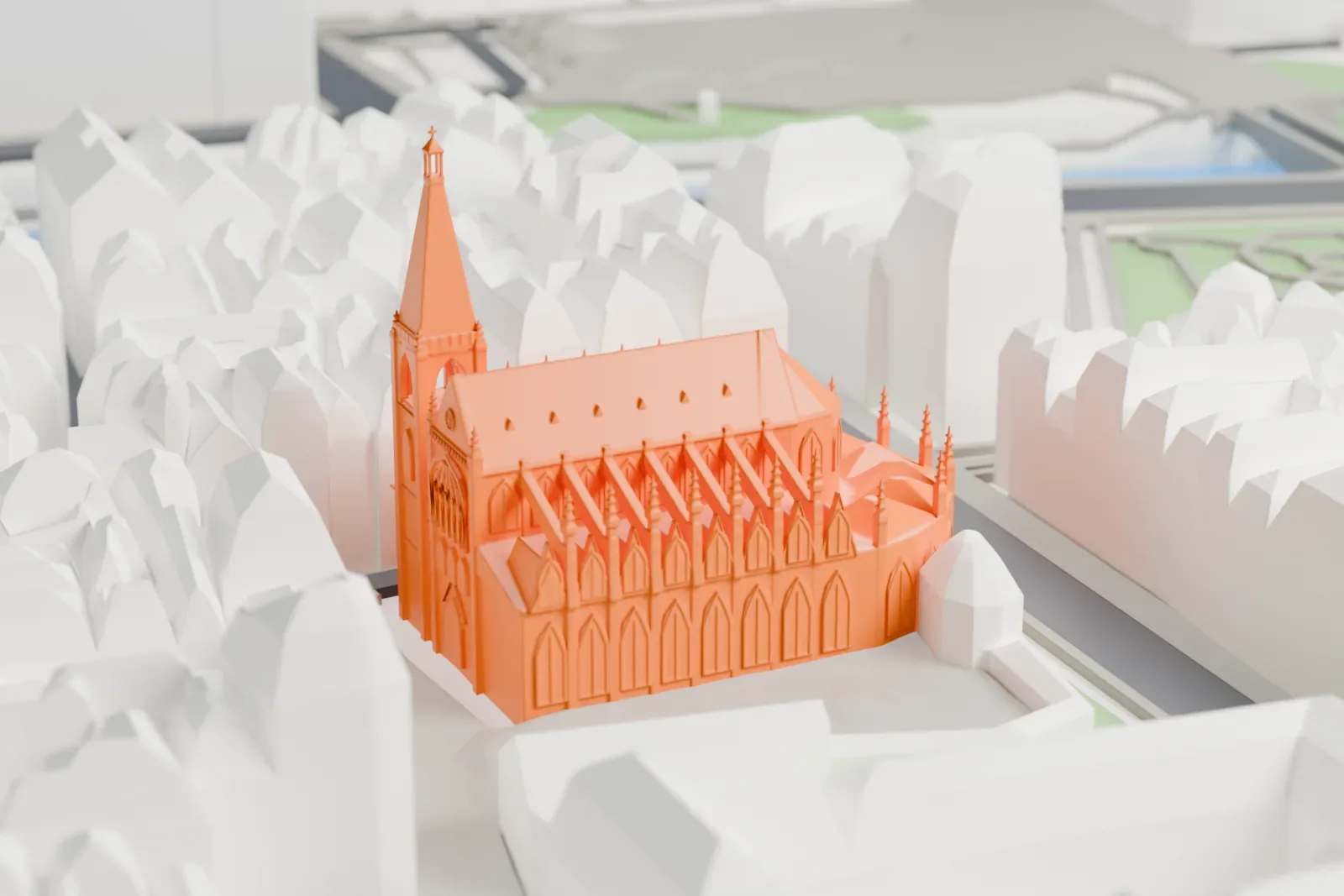
3D print Saint-Séverin, Paris
A free, printable model of the Gothic church in Paris's Latin Quarter, with the streets and buildings around it, generated from real map data in your browser.
-
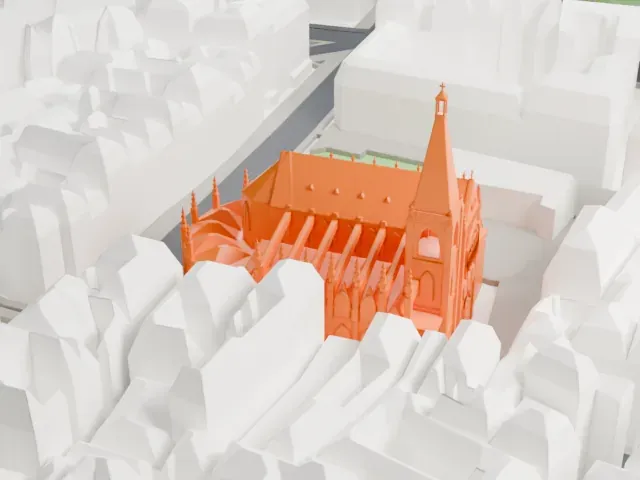 North
-
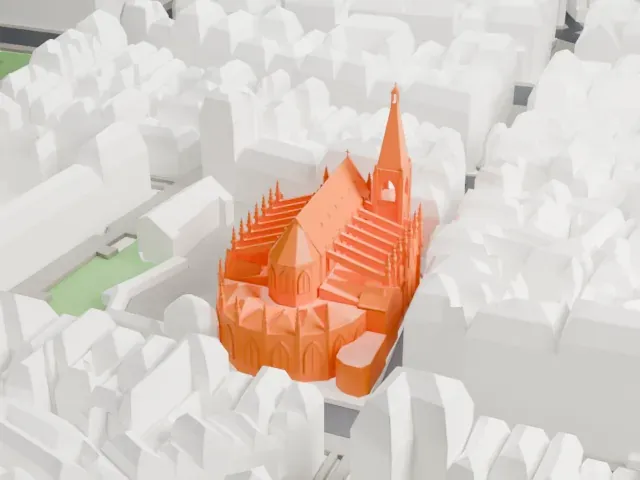 East
-
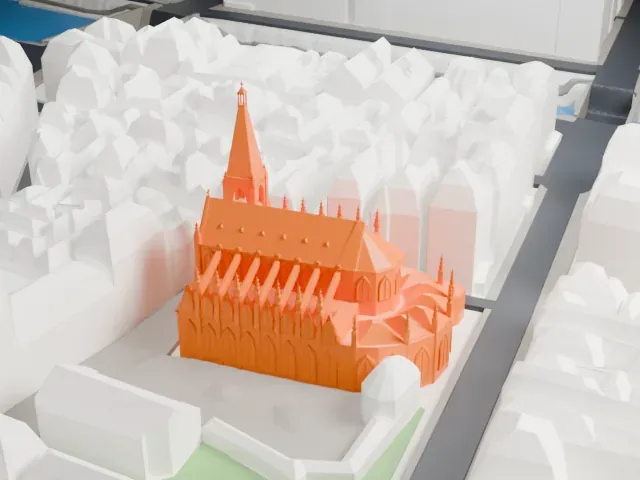 South
-
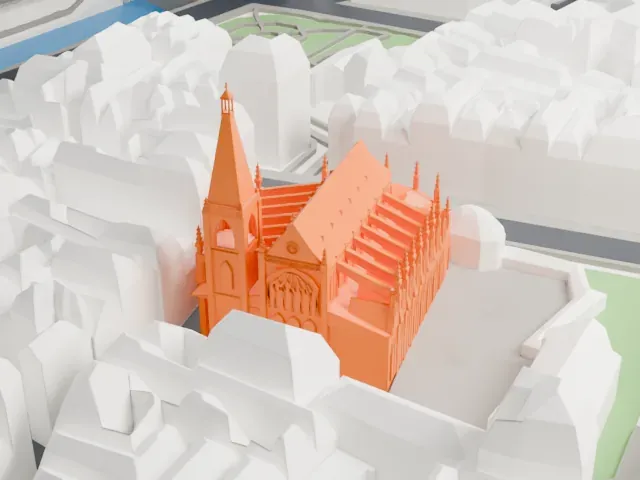 West
- On a 160 mm print
- 14 mm
- Scale
- 1:3,750
14 mm tall on a 160 mm print
Make this print opens the generator on a 600 m square around the landmark. Buildings print at close to true scale, so the landmark grows with the print size.
- A church at print scale
A church model reads best at a larger print size, where the roofline and wall surfaces stay distinct. Below that, Print friendly adapts thin parts and small details to the scale.
- One piece with the ground
Saint-Séverin, Paris is joined to the ground in the exported file, and the four-side check found no floating parts, so nothing needs gluing.
- Pick the detail for your nozzle
In the Buildings settings, set Landmark detail to Print friendly to adapt thin parts and small details to the print scale. Full detail keeps every modeled feature, for larger prints or a finer nozzle.
- Colors
Buildings, roads, water and ground arrive as separate filament slots in the 3MF. Saint-Séverin, Paris takes the building color.
- File format
You get a 3MF for Bambu Studio, OrcaSlicer or PrusaSlicer. Any of them can save it as STL if you need one.
About Saint-Séverin, Paris
Saint-Séverin stands in the 5th arrondissement of Paris, in the Latin Quarter, on Rue Saint-Séverin. Work started in 1230; after a fire, the church was rebuilt and enlarged in the Flamboyant Gothic style, from the 15th through the 17th century. Students at the University of Paris used it as their parish church, and it ranks among the oldest surviving churches on the Left Bank.
Its name comes from Saint Séverin of Paris, a hermit who made his home there in the 6th century and died around 540. A chapel rose over his cell after his death; the Norman invasions destroyed it in the 9th century, and it was rebuilt in Romanesque style in the 11th. With the university founded in 1215, Saint-Séverin became its parish church, and growth in the student body called for a larger building. Work on the High Gothic church started around 1230, at the same time as Notre-Dame and Sainte-Chapelle.
A fire in 1448 did serious damage during the Hundred Years' War. Guillaume d'Estouteville, the archpriest, then began a rebuild in the more ornamental Flamboyant manner, adding a north aisle and, in 1489, a semicircular apse and ambulatory wrapped around a spiral central pillar. A ring of radiating chapels followed, and the work reached completion in 1520, giving the church broadly its present look. Jules Hardouin-Mansart, the royal architect, added a communion chapel at the southeast corner in 1673. The French Revolution closed the church, which then stored gunpowder, grain and bells.
About this model
Saint-Séverin, Paris is one of more than 4,400 landmark models in Mini Skyline. They are made with AI, and each one is checked from four sides in its real surroundings before release. Everything around it is built from OpenStreetMap and Overture map data. If you would rather print the shape from map data, turn off Landmark models in the Buildings settings.
Same skyline