3D print Shitennō-ji
A free, printable model of Shitennō-ji's Golden Pavilion in Ōsaka, with the surrounding city, generated from real map data in your browser.
-
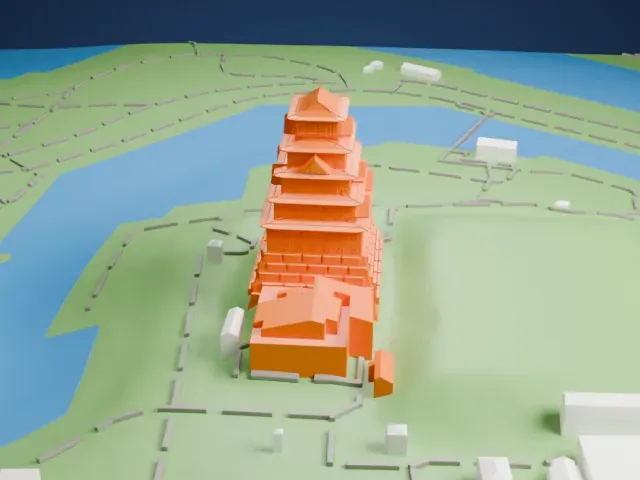
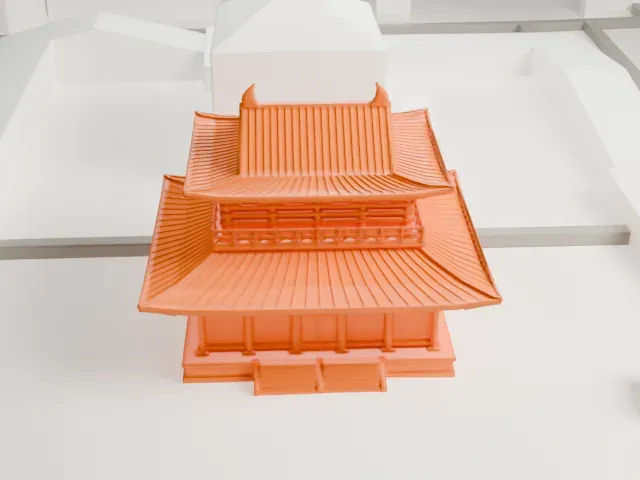 North
-
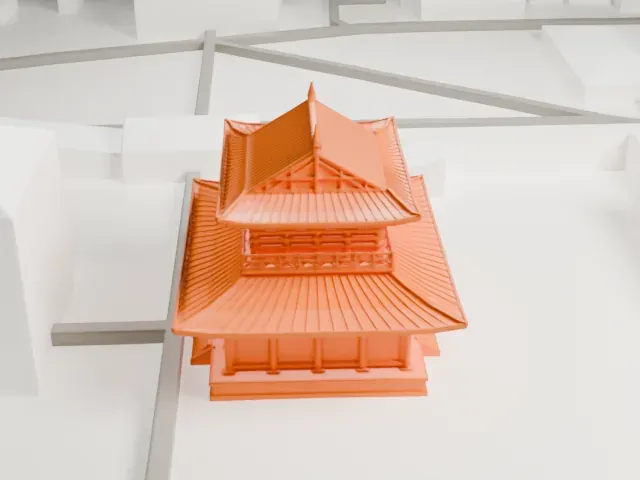 East
-
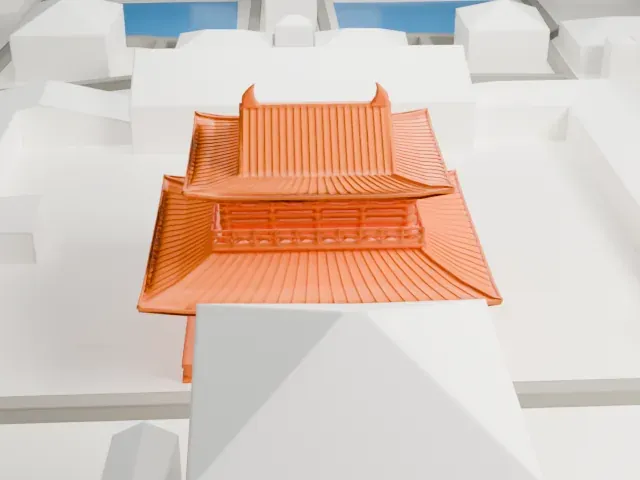 South
-
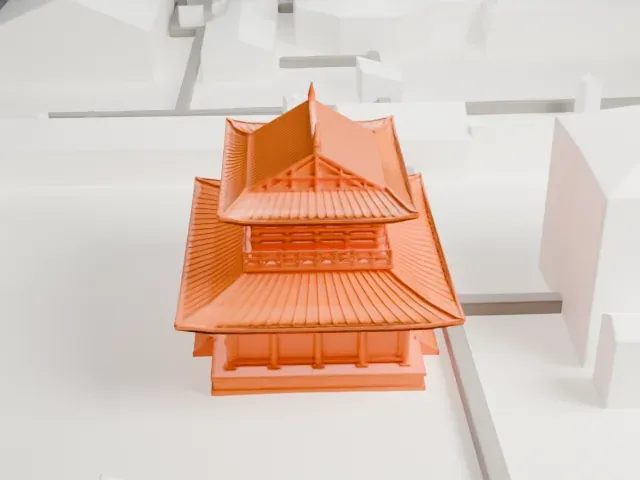 West
The model you print
Shitennō-ji in 3D
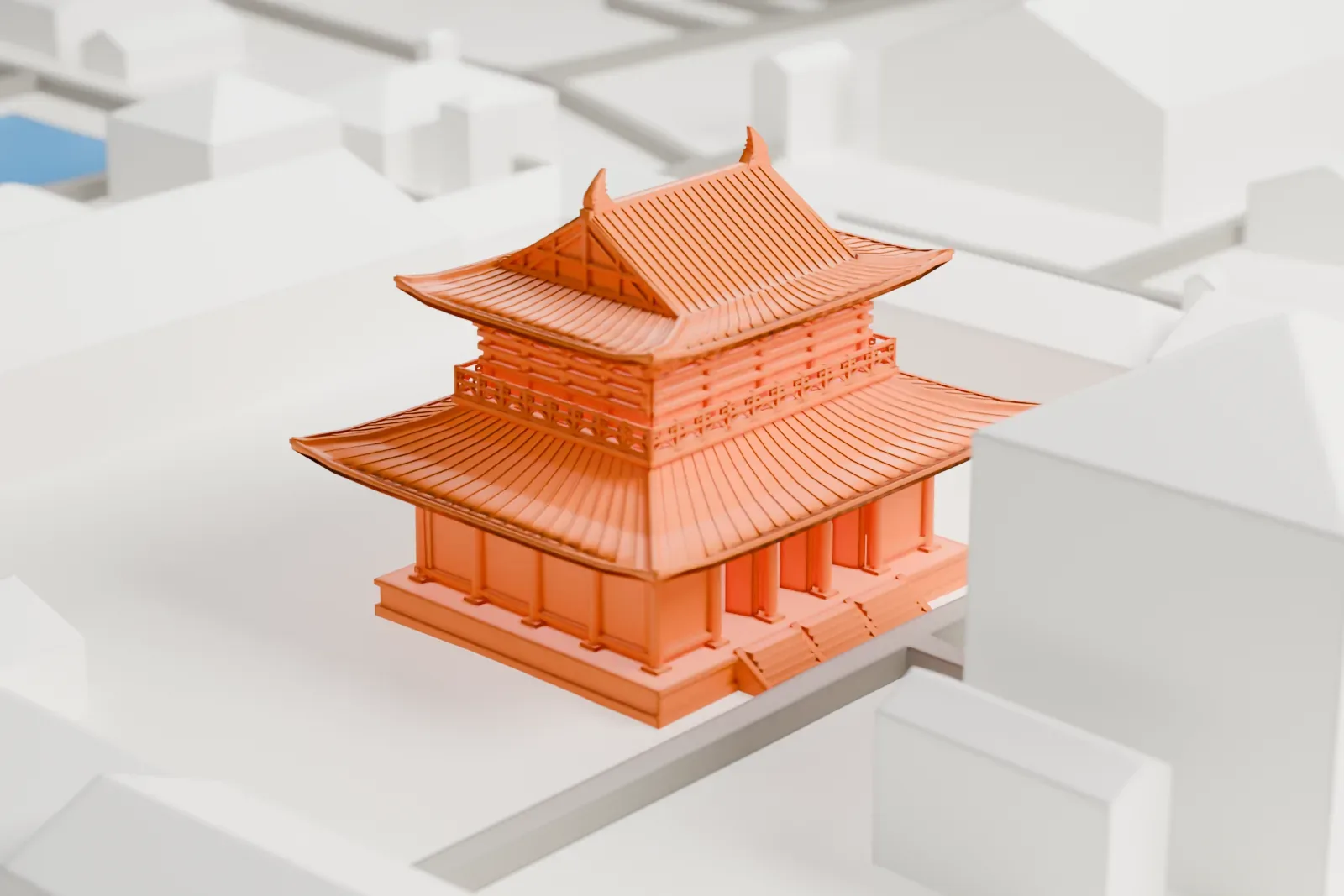
The landmark on its own, at its size on a 160 mm print. Print friendly thickens thin parts for a 0.4 mm nozzle; Full detail keeps every part.
- On a 160 mm print
- 5 mm
- Scale
- 1:3,750
5 mm tall on a 160 mm print
Make this print opens the generator on a 600 m square around the landmark. Buildings print at close to true scale, so the landmark grows with the print size.
- Curved roofs and ornaments
The Golden Pavilion has two curved tiled roof levels and paired ornaments at the ridge. Print friendly simplifies the tile rolls and brackets; Full detail keeps them for a large print.
- Balcony and brackets
The upper balcony carries a stepped fret and many small triangular supports. Slower printing with good cooling and 0.12–0.16 mm layers helps these fine repeated shapes.
- One piece with the ground
Shitennō-ji is joined to the ground in the exported file, and the four-side check found no floating parts, so nothing needs gluing.
- Pick the detail for your nozzle
In the Buildings settings, set Landmark detail to Print friendly to adapt thin parts and small details to the print scale. Full detail keeps every modeled feature, for larger prints or a finer nozzle.
- Colors
Buildings, roads, water and ground arrive as separate filament slots in the 3MF. Shitennō-ji takes the building color.
- File format
You get a 3MF for Bambu Studio, OrcaSlicer or PrusaSlicer. Any of them can save it as STL if you need one.
About Shitennō-ji
Shitennō-ji, a Buddhist temple in Ōsaka, Japan, is also known as the Temple of the Four Heavenly Kings. It also carries the names Arahaka-ji, Nanba-ji or Naniwa-daiji, and Mitsu-ji. Some regard it as Japan's first Buddhist temple and its oldest officially administered one, though the complex and its buildings have been rebuilt repeatedly over the centuries, the latest in 1963. Soon after World War II the temple left the Tendai sect to form the Wa sect.
Prince Shōtoku ordered its construction in the 6th century, when Buddhism had not yet spread widely in Japan, as part of a national campaign to promote the faith. He brought in three Korean carpenters from Baekje, whose knowledge guided the work. A person involved in that original build later founded Kongō Gumi, a temple-and-shrine builder that remained the world's oldest company until the Takamatsu Construction Group bought it in 2004.
The garan, the walled complex inside the temple, includes a five-story pagoda and the Kondō, or Golden Pavilion, which holds an image of the Bodhisattva Kannon. A lecture hall and a covered corridor with three gates completed the group. Four institutions were meant to help raise the level of civilization: religion and education, welfare, a hospital and a pharmacy. Records show that three of them still existed within the temple in the Kamakura period.
About this model
Shitennō-ji is one of more than 4,900 landmark models in Mini Skyline. They are made with AI, and each one is checked from four sides in its real surroundings before release. Everything around it is built from OpenStreetMap and Overture map data. If you would rather print the shape from map data, turn off Landmark models in the Buildings settings.
Same skyline