3D print the Stroganov Palace
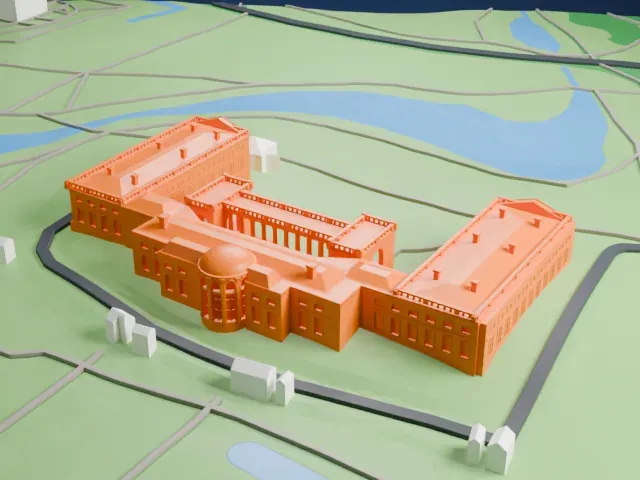
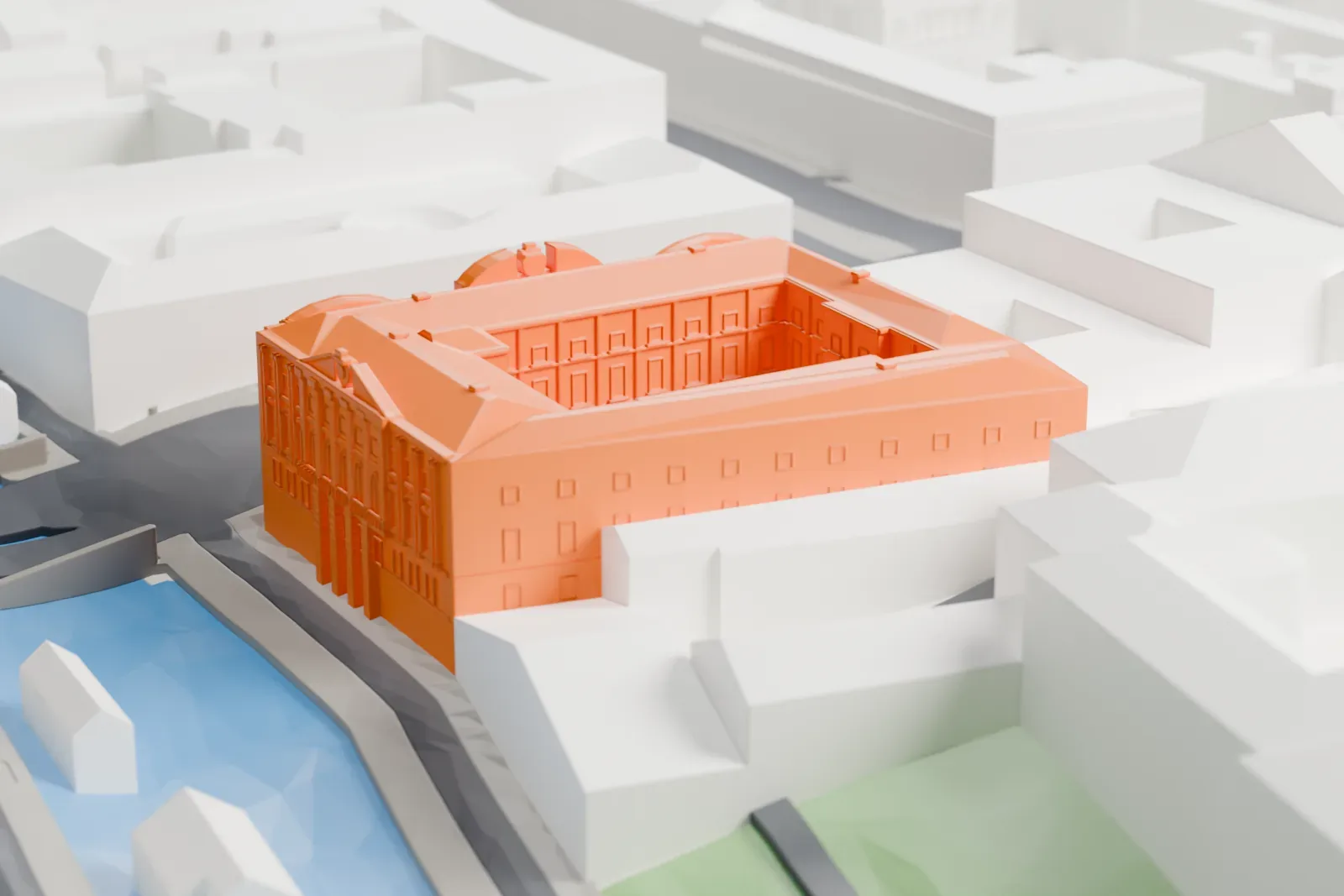
A free, printable model of the Stroganov Palace in Saint Petersburg, at the point where the Moika River meets Nevsky Prospect, generated from real map data in your browser.
-
 North
-
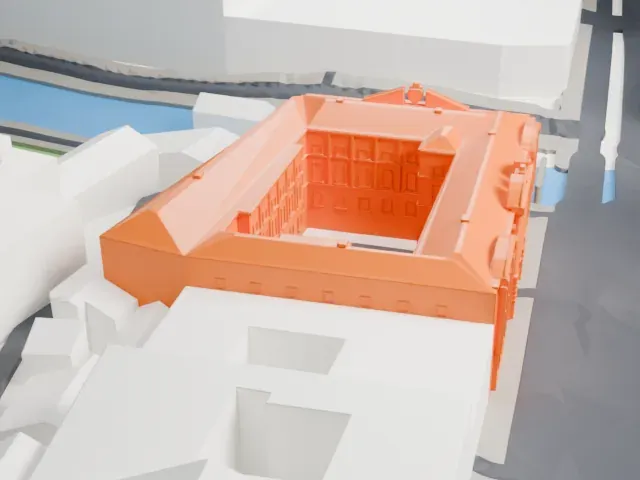 East
-
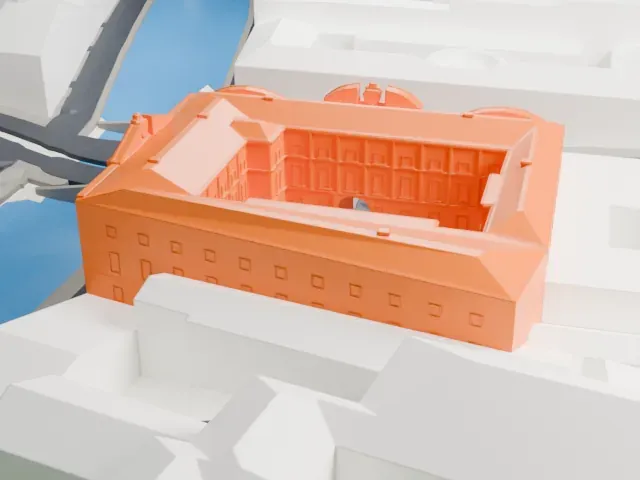 South
-
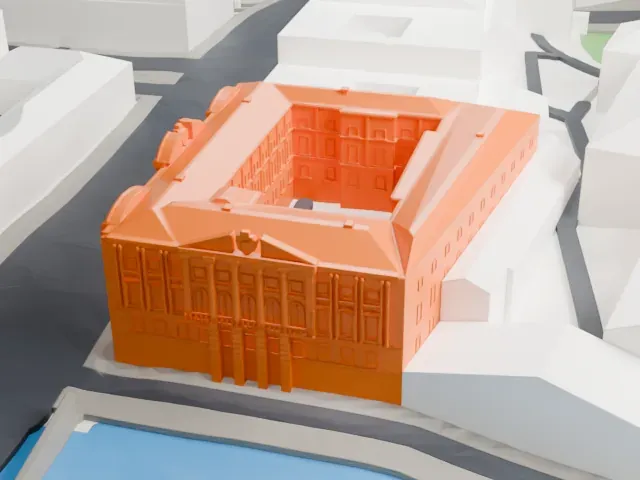 West
- On a 160 mm print
- 8 mm
- Scale
- 1:3,750
8 mm tall on a 160 mm print
Make this print opens the generator on a 600 m square around the landmark. Buildings print at close to true scale, so the landmark grows with the print size.
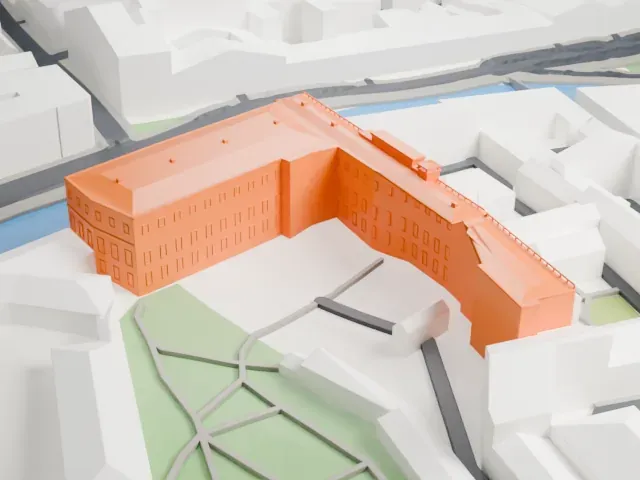
- A long palace front
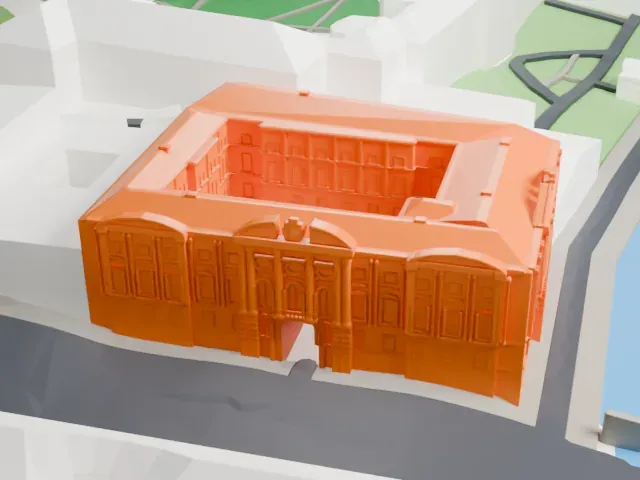
The palace presents a broad facade with rows of windows and a central entrance, and those recesses soften first on a small print. Print larger, or use Print friendly with 0.12–0.16 mm layers.
- One piece with the ground
The Stroganov Palace is joined to the ground in the exported file, and the four-side check found no floating parts, so nothing needs gluing.
- Pick the detail for your nozzle
In the Buildings settings, set Landmark detail to Print friendly to adapt thin parts and small details to the print scale. Full detail keeps every modeled feature, for larger prints or a finer nozzle.
- Colors
Buildings, roads, water and ground arrive as separate filament slots in the 3MF. The Stroganov Palace takes the building color.
- File format
You get a 3MF for Bambu Studio, OrcaSlicer or PrusaSlicer. Any of them can save it as STL if you need one.
About the Stroganov Palace
Bartolomeo Rastrelli designed this Late Baroque palace for Baron Sergei Grigoriyevich Stroganov, and it went up in 1753–1754 where the Moika River meets Nevsky Prospect in Saint Petersburg. At the start of the 19th century Andrei Voronikhin reworked the interiors. Its main facade faces Nevsky Prospect and has a Corinthian-columned entrance arch.
A first Stroganov house probably stood on the site from the 1720s, a single story; Mikhail Zemtsov followed it in the 1740s with a two-story house. The baron asked Rastrelli for a palace design in 1752, while the architect was enlarging the Catherine Palace and raising the Smolny Convent for Empress Elisabeth. As the wealthiest family in Russia and kin to the Empress through marriage, the Stroganovs could not be refused, and Rastrelli produced a townhouse design in haste.
After the October Revolution the remaining Stroganovs emigrated, and the palace was nationalized. The museum within it closed in 1929, with many contents, among them prized paintings and objects, transferred to the Hermitage Museum. The Russian Museum received the building in 1988 and uses it as a branch for exhibitions. Its light pink walls follow Rastrelli's original scheme, and it ranks among the few Baroque buildings on Nevsky Prospect that keep their original appearance.
About this model
The Stroganov Palace is one of more than 4,400 landmark models in Mini Skyline. They are made with AI, and each one is checked from four sides in its real surroundings before release. Everything around it is built from OpenStreetMap and Overture map data. If you would rather print the shape from map data, turn off Landmark models in the Buildings settings.
Same skyline