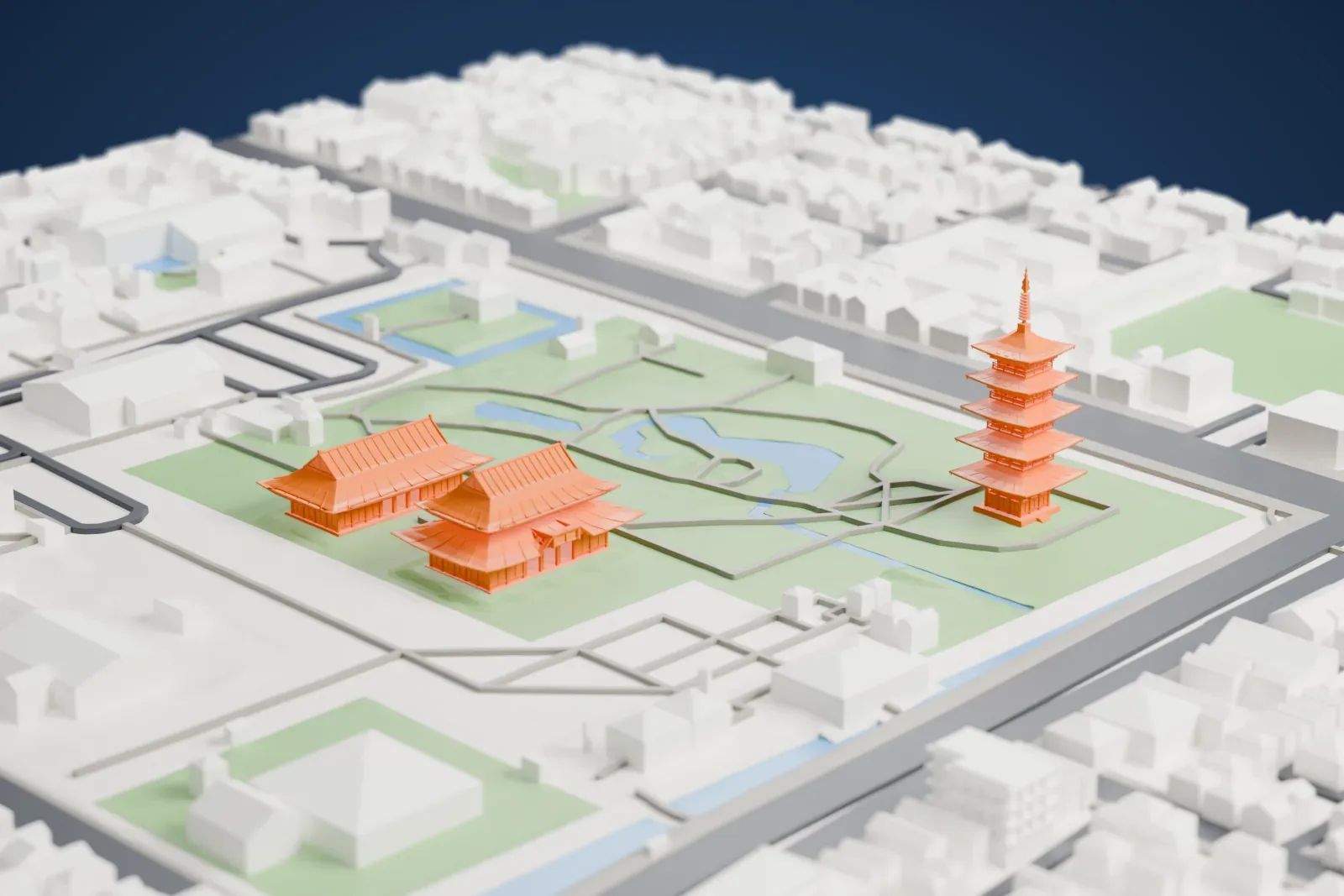
3D print Tō-ji
A free, printable model of Tō-ji, with its five-storied pagoda and temple halls among the surrounding streets and buildings of Kyoto, generated from real map data in your browser.
-
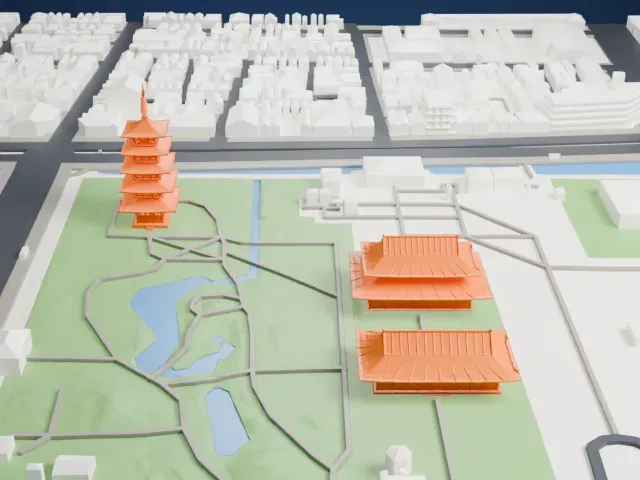 North
-
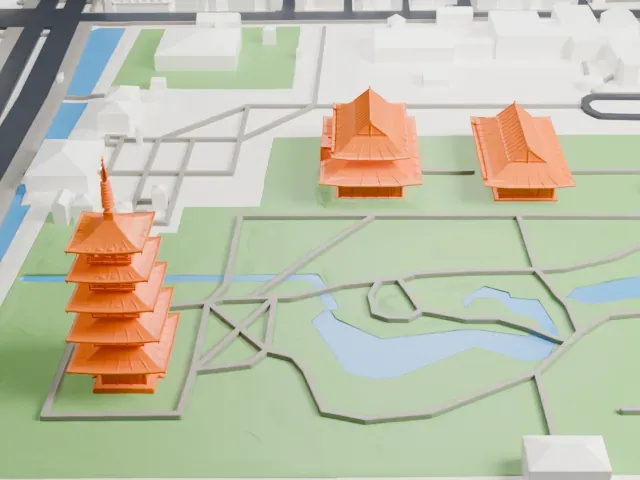 East
-
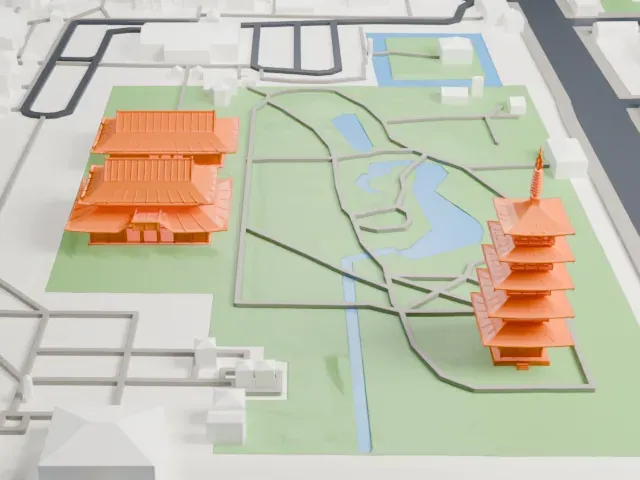 South
-
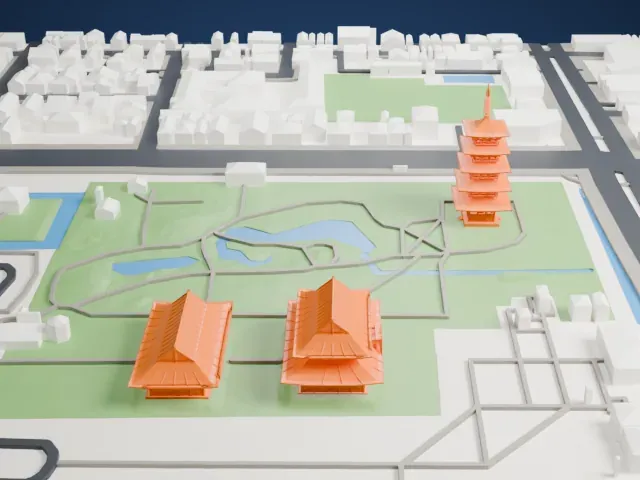 West
The model you print
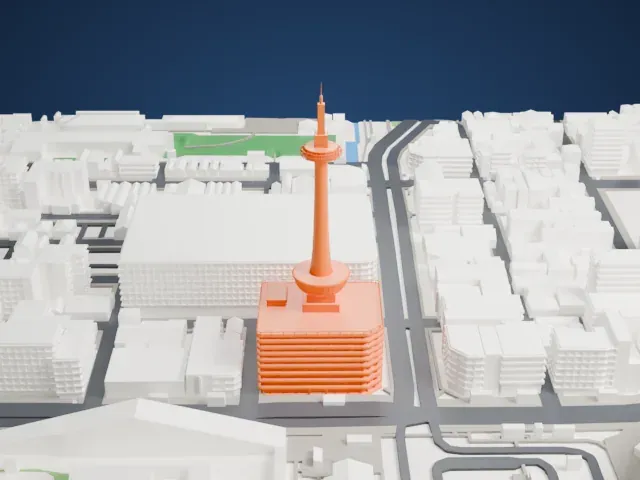
Tō-ji in 3D
The landmark on its own, at its size on a 160 mm print. Print friendly thickens thin parts for a 0.4 mm nozzle; Full detail keeps every part.
- Real height
- 55 m
- On a 160 mm print
- 15 mm
- Scale
- 1:3,750
55 m of Tō-ji, 15 mm on your shelf
Make this print opens the generator on a 600 m square around the landmark. Buildings print at close to true scale, so the landmark grows with the print size.
- Fine detail on the pagoda
The pagoda's five roofs, open galleries and ringed finial carry the model's finest detail. Print larger or use Full detail to keep them crisp; Print friendly adapts them to a smaller print.
- Thin layers for the finial
The finial is a tall, slender feature, and the eave edges are thin. Layers of 0.12 to 0.16 mm help them stay sharp, and printing slowly with cooling helps the narrow top.
- One piece with the ground
Tō-ji is joined to the ground in the exported file, and the four-side check found no floating parts, so nothing needs gluing.
- Pick the detail for your nozzle
In the Buildings settings, set Landmark detail to Print friendly to adapt thin parts and small details to the print scale. Full detail keeps every modeled feature, for larger prints or a finer nozzle.
- Colors
Buildings, roads, water and ground arrive as separate filament slots in the 3MF. Tō-ji takes the building color.
- File format
You get a 3MF for Bambu Studio, OrcaSlicer or PrusaSlicer. Any of them can save it as STL if you need one.
About Tō-ji
Tō-ji is a Shingon Buddhist temple in Kyoto, Japan, in the city's Minami-ku ward. Its grounds sit by the crossing of Ōmiya and Kujō streets, southwest of Kyōto Station. It was founded in 796, two years after Heian-kyō became the capital. At the time the city became the capital, only three Buddhist temples were permitted there, and Tō-ji is the only one of them that survives. The temple is often associated with Kōbō Daishi, also known as Kūkai, who was put in charge of it in 823 on Emperor Saga's orders.
Its buildings span the Kamakura, Muromachi, Momoyama and Edo eras, and the complex holds early Heian period and Tang dynasty treasures and documents. Five of its buildings are National Treasures: the Lotus Flower Gate, the Miei Hall, the Golden Hall, the five-storied Pagoda and the Kanchiin Guest Hall. The pagoda is Japan's tallest wooden tower at 54.8 meters (180 feet). The present one dates from 1643, when the third Tokugawa shōgun, Iemitsu, ordered it rebuilt, and it received National Treasure status in 1952.
UNESCO added Tō-ji to its World Heritage list in 1994, within the Historic Monuments of Ancient Kyoto. A flea market called Kōbō-san is held on the temple grounds on the 21st of each month in honor of Kūkai, and the largest is on December 21, the last of the year. The grounds also include a garden and pond with turtles and koi.
About this model
Tō-ji is one of more than 4,900 landmark models in Mini Skyline. They are made with AI, and each one is checked from four sides in its real surroundings before release. Everything around it is built from OpenStreetMap and Overture map data. If you would rather print the shape from map data, turn off Landmark models in the Buildings settings.
Same skyline