3D print the Wernigerode Castle
A free, printable model of Wernigerode Castle on its green hillside, with the nearby walls and buildings, generated from real map data in your browser.
-
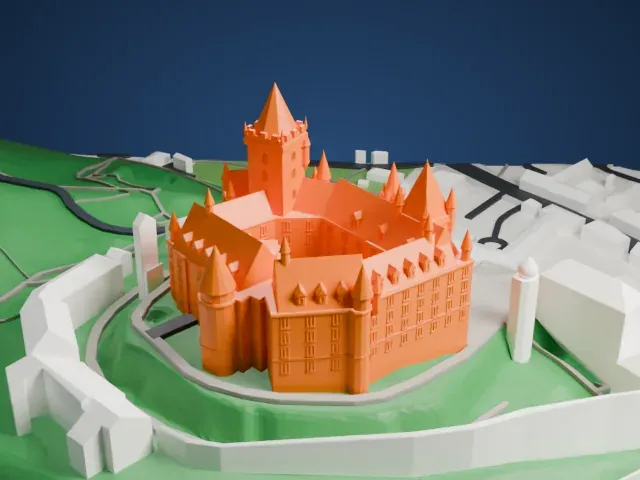 North
-
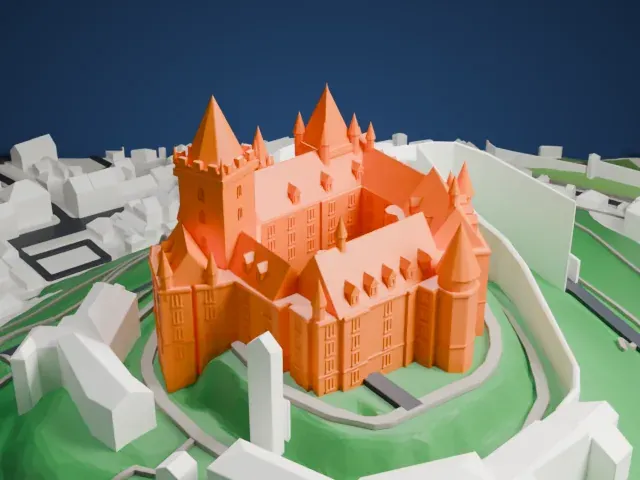 East
-
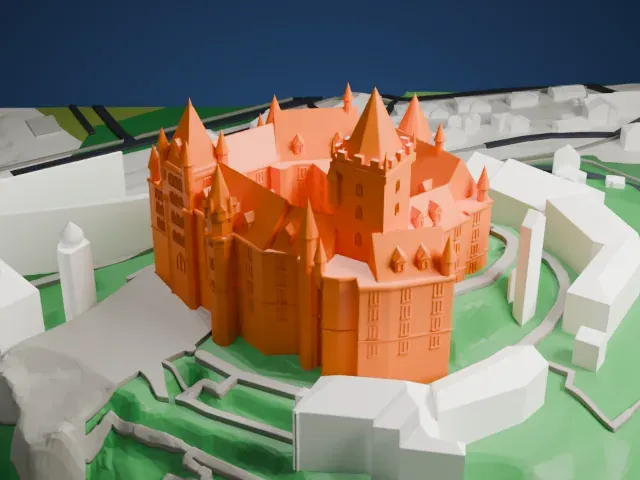 South
-
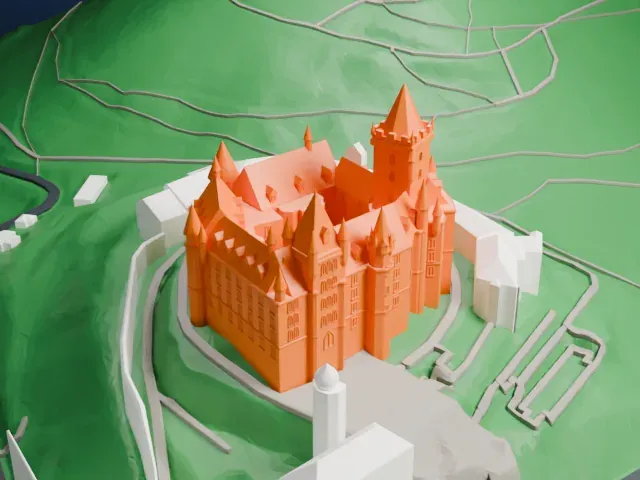 West
The model you print
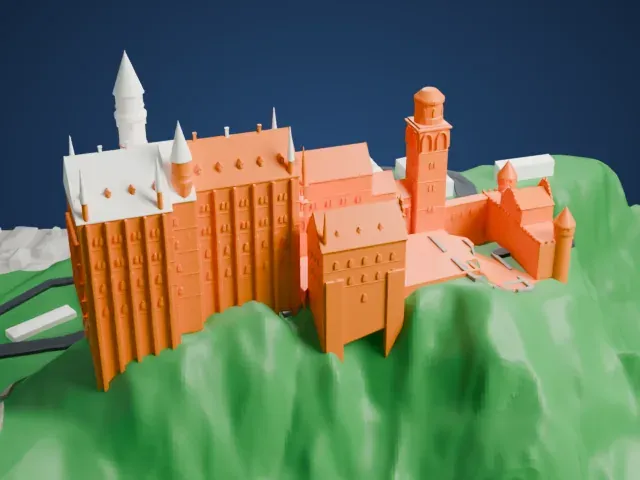
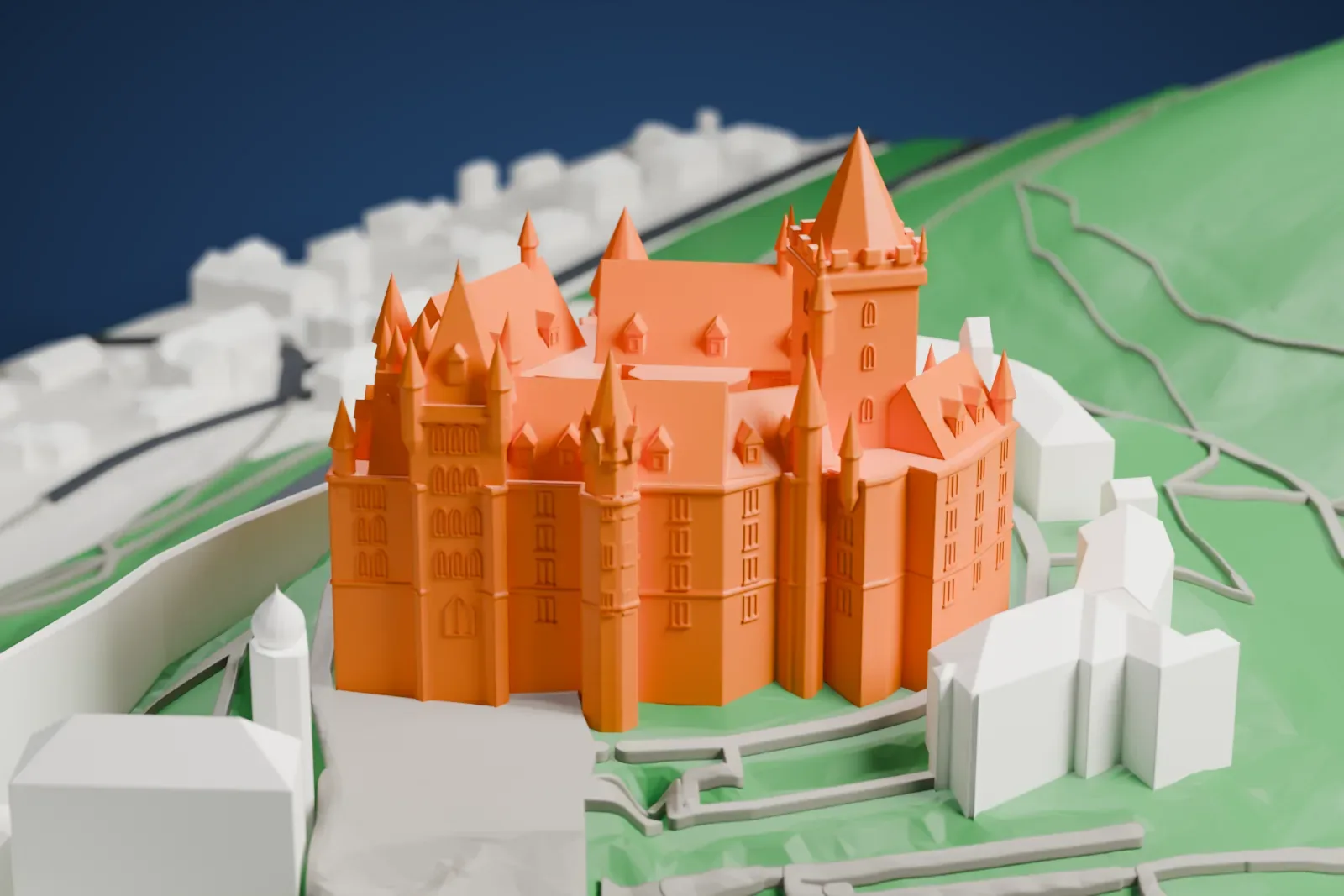
Wernigerode Castle in 3D
The landmark on its own, at its size on a 160 mm print. Print friendly thickens thin parts for a 0.4 mm nozzle; Full detail keeps every part.
- On a 160 mm print
- 15 mm
- Scale
- 1:3,750
15 mm tall on a 160 mm print
Make this print opens the generator on a 600 m square around the landmark. Buildings print at close to true scale, so the landmark grows with the print size.
- Many small turrets and dormers
Pointed turrets, spires and roof dormers crowd the roofline. Print friendly adapts the thinnest to the print scale; Full detail keeps all of them, best on a larger print with a fine nozzle.
- Slow cooling for turret tips
Print slowly with good cooling so the narrow turret tips can harden between layers, and use a layer height of 0.12–0.16 mm to keep the roof edges crisp.
- One piece with the ground
The Wernigerode Castle is joined to the ground in the exported file, and the four-side check found no floating parts, so nothing needs gluing.
- Pick the detail for your nozzle
In the Buildings settings, set Landmark detail to Print friendly to adapt thin parts and small details to the print scale. Full detail keeps every modeled feature, for larger prints or a finer nozzle.
- Colors
Buildings, roads, water and ground arrive as separate filament slots in the 3MF. The Wernigerode Castle takes the building color.
- File format
You get a 3MF for Bambu Studio, OrcaSlicer or PrusaSlicer. Any of them can save it as STL if you need one.
About the Wernigerode Castle
Wernigerode Castle, called Schloss Wernigerode in German, stands above the town of Wernigerode, in the Harz mountains of Saxony-Anhalt, Germany. The building seen today was completed late in the 19th century and resembles Schloss Neuschwanstein in style, but its foundations are far older and were rebuilt more than once. A Romanesque fortress first stood here around 1110 to 1120, giving German emperors a safe place to stop on their hunting trips in the Harz.
The counts of Wernigerode built the castle as their residence, and the first mention of it as a castrum dates from 1213. Late in the 15th century it gained a Gothic enlargement with large arched windows, and during the 16th century it became a Renaissance fortress. A tower holding a spiral staircase survives intact. The Thirty Years' War left the castle heavily damaged, and in 1710 Count Christian Ernest had it rebuilt as a Baroque schloss.
Count Otto later had the schloss extensively rebuilt in a Neo-Romantic style, half timber and half stone, known as historicism, and finished the project in 1893. The complex includes a chapel by the architect Carl Frühling, based on drafts by the Vienna architect Friedrich von Schmidt. The chapel hall has built-in galleries, and the choir has stained glass designed by the artist Carl Christian Andrea.
About this model
The Wernigerode Castle is one of more than 6,500 landmark models in Mini Skyline. They are made with AI, and each one is checked in its real surroundings before release. Each model is written as code from public descriptions, plans, photographs and aerial views used only as references; no image or third-party model is copied into it. Everything around it is built from OpenStreetMap and Overture map data. Rights in the building itself, its name and any brands on it are not granted by Mini Skyline; clear them separately before you sell prints. If you would rather print the shape from map data, turn off Landmark models in the Buildings settings.
Mini Skyline is not affiliated with, or endorsed by, the owners of this building or its names and marks.
Keep exploring