3D print the Stadio Armando Picchi
A free, printable 3D model of the Stadio Armando Picchi and its surrounding streets and buildings, generated from real map data in your browser.
-
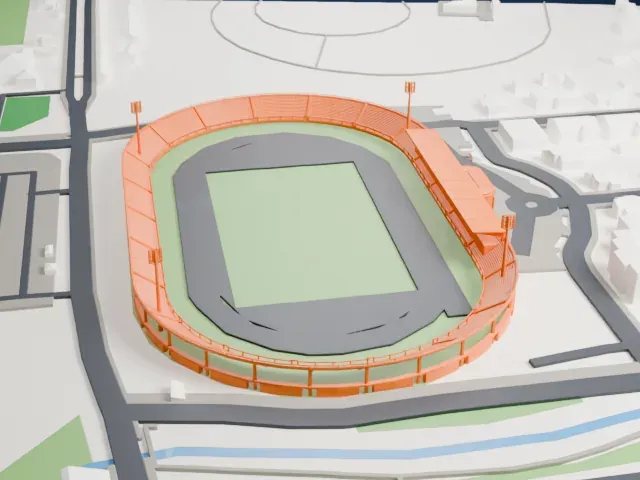 North
-
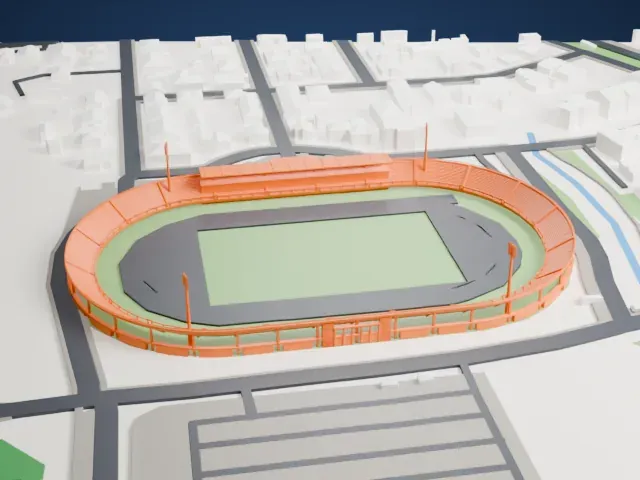 East
-
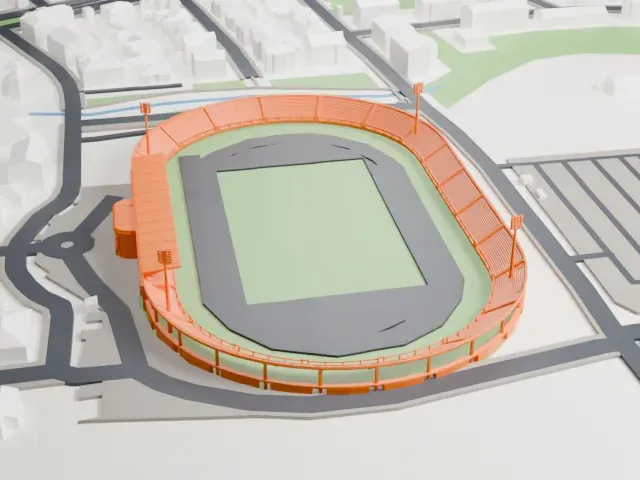 South
-
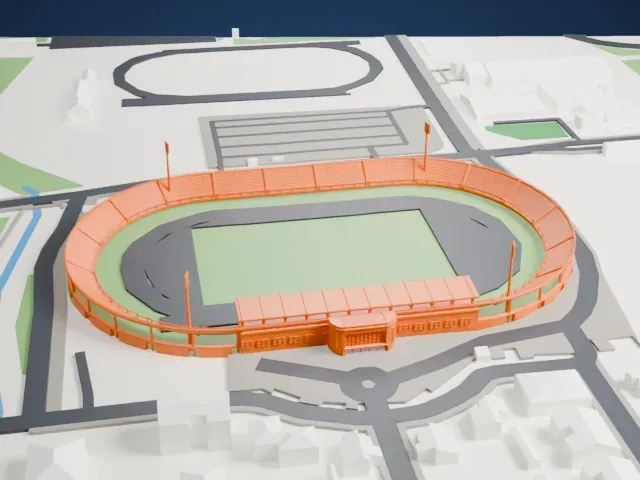 West
The model you print
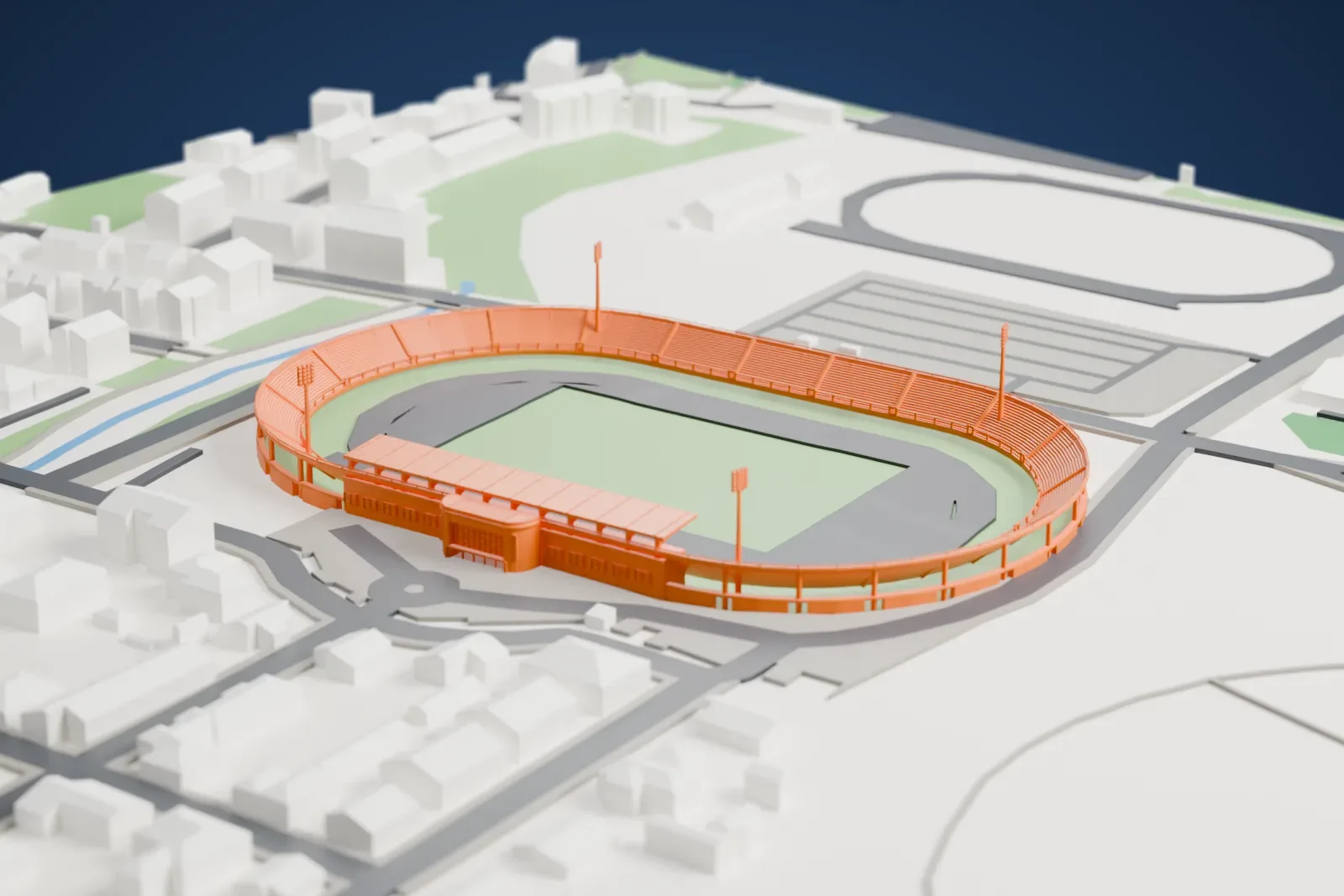
Stadio Armando Picchi in 3D
The landmark on its own, at its size on a 160 mm print. Print friendly thickens thin parts for a 0.4 mm nozzle; Full detail keeps every part.
- On a 160 mm print
- 9 mm
- Scale
- 1:3,750
9 mm tall on a 160 mm print
Make this print opens the generator on a 600 m square around the landmark. Buildings print at close to true scale, so the landmark grows with the print size.
- West entrance and canopy
The west side carries the model's only roof, a cantilever over the stand, with a projecting entrance hall below. Print at Full detail or a larger size so the curved shoulders and door bays stay sharp.
- Open bowl and masts
The rest of the oval is open seating around a hollow field, with four slender floodlight poles. A 0.12–0.16 mm layer height keeps the thin masts and terrace rows clean.
- One piece with the ground
The Stadio Armando Picchi is joined to the ground in the exported file, and the four-side check found no floating parts, so nothing needs gluing.
- Pick the detail for your nozzle
In the Buildings settings, set Landmark detail to Print friendly to adapt thin parts and small details to the print scale. Full detail keeps every modeled feature, for larger prints or a finer nozzle.
- Colors
Buildings, roads, water and ground arrive as separate filament slots in the 3MF. The Stadio Armando Picchi takes the building color.
- File format
You get a 3MF for Bambu Studio, OrcaSlicer or PrusaSlicer. Any of them can save it as STL if you need one.
About the Stadio Armando Picchi
The Stadio Armando Picchi in Livorno, Italy, serves several sports. The city's club, A.S. Livorno Calcio, first used the Villa Chayes Stadium, a ground attached to the nearby Naval Academy, but after promotion to Serie A in 1928–29 it needed a bigger ground. Raffaello Brizzi designed the new stadium, which was built in 1933 at Ardenza Mare.
It was built in reinforced concrete, covers an area of 30,000 square meters, and has two straight stands about 90 meters long. Its original capacity was 19,234. The first match, Livorno against ACF Fiorentina, was played on October 8, 1933, while the stadium was still incomplete. After the war it was used by American personnel from the nearby Camp Darby base, who called it Yankee Stadium for the occasion. It hosted football preliminaries for the 1960 Summer Olympics and in 1971 took the name of Armando Picchi, a Livorno-born footballer.
About this model
The Stadio Armando Picchi is one of more than 4,900 landmark models in Mini Skyline. They are made with AI, and each one is checked from four sides in its real surroundings before release. Everything around it is built from OpenStreetMap and Overture map data. If you would rather print the shape from map data, turn off Landmark models in the Buildings settings.
Keep exploring