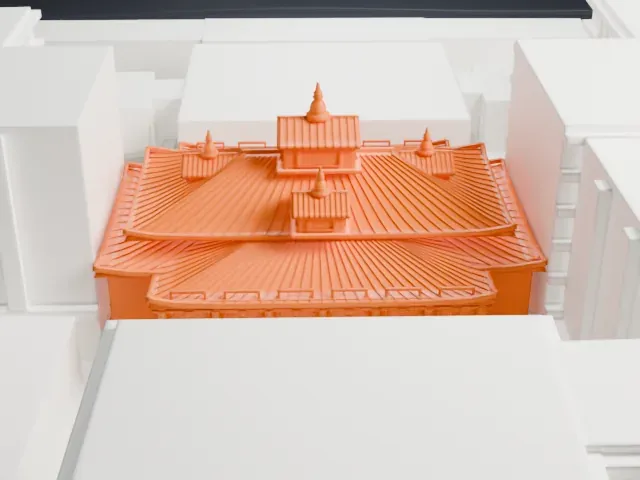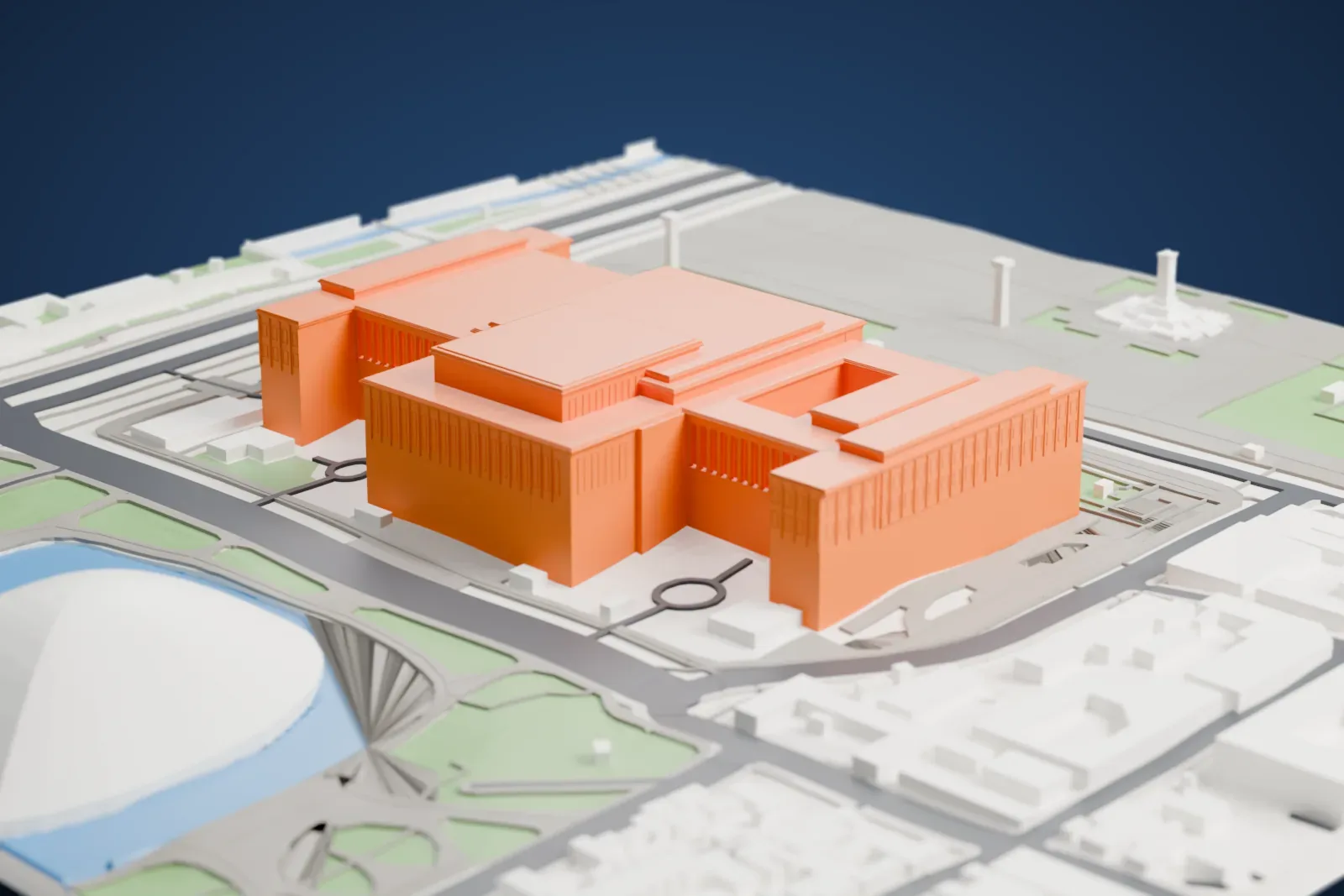
Great Hall of the People in 3D
The Great Hall of the People appears in city models you make here; its design may still be protected, so it isn't offered as a separate download.
-
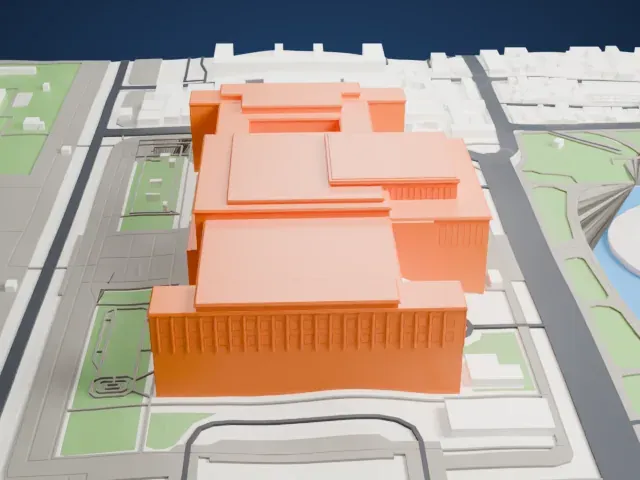 North
-
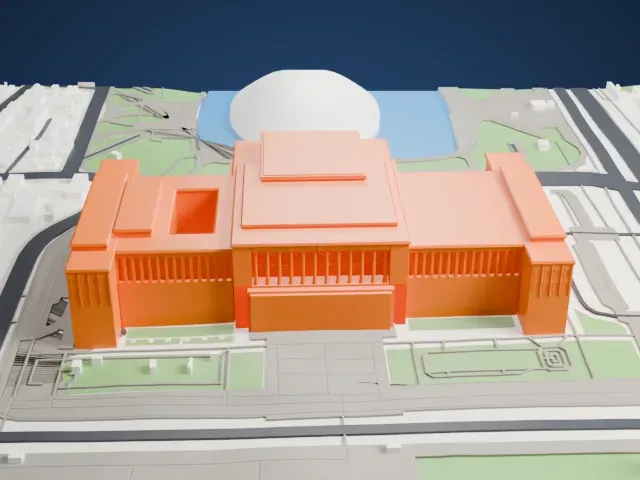 East
-
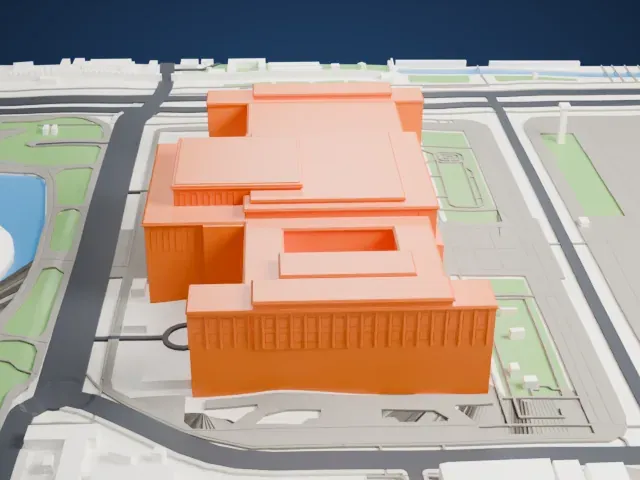 South
-
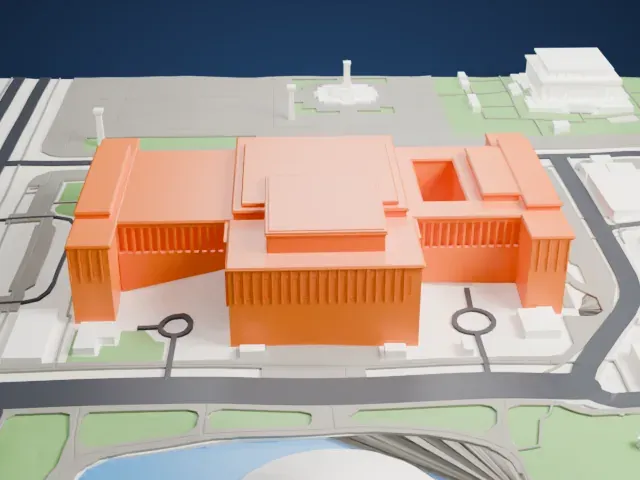 West
Copyright notice
The design of Great Hall of the People may still be protected by copyright. It appears in the city models you make here, but it is not offered as a separate model.
- On a 160 mm print
- 16 mm
- Scale
- 1:5,000
16 mm tall on a 160 mm print
Make this print opens the generator on a 800 m square around the landmark. Buildings print at close to true scale, so the landmark grows with the print size.
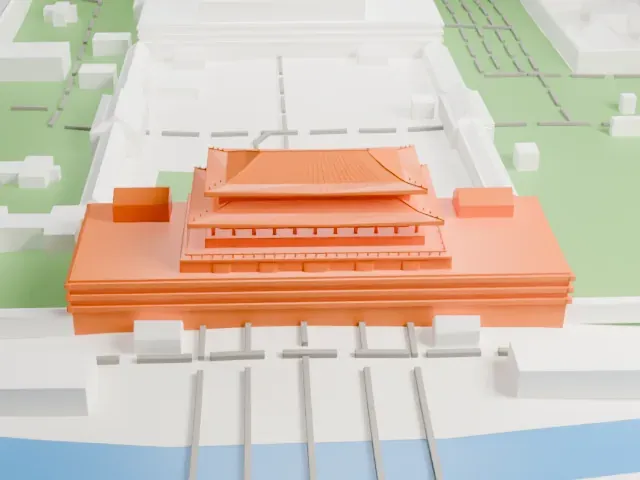
- Wide stepped roofs and window rows
The building is a broad mass of stacked blocks with fine window rows on the walls. Print friendly keeps these readable at print scale; Full detail keeps every row, which suits a larger print and a layer height of 0.12-0.16 mm.
- One piece with the ground
The Great Hall of the People is joined to the ground in the exported file, and the four-side check found no floating parts, so nothing needs gluing.
- Pick the detail for your nozzle
In the Buildings settings, set Landmark detail to Print friendly to adapt thin parts and small details to the print scale. Full detail keeps every modeled feature, for larger prints or a finer nozzle.
- Colors
Buildings, roads, water and ground arrive as separate filament slots in the 3MF. The Great Hall of the People takes the building color.
- File format
You get a 3MF for Bambu Studio, OrcaSlicer or PrusaSlicer. Any of them can save it as STL if you need one.
About the Great Hall of the People
On the west side of Tiananmen Square in Beijing stands the Great Hall of the People, a state building for China's legislative and ceremonial business. Each March it hosts the full sessions of the National People's Congress. It also hosts the Chinese Communist Party's National Congress, held once every five years since 1982.
The hall was one of the "Ten Great Constructions" finished to mark the 10th anniversary of the People's Republic, and it opened in September 1959. The design of Zhao Dongri and Shen Qi won out among entries judged by architects from across the country, and Zhang Bo served as chief architect. Construction took 10 months and 7,785 workers. Mao Zedong gave the building its final name.
It has 171,801 square meters of floor space, or 1,849,250 sq ft. The building is 356 meters (1,168 ft) long and 206.5 meters (677 ft) wide, and the center climbs to 46.5 meters (153 ft) at its highest. It has three sections: a central section with the Great Auditorium, a northern section with the State Banquet Hall, and a southern office building. The Great Auditorium can seat 10,000 representatives at once.
About this model
The Great Hall of the People is one of more than 6,500 landmark models in Mini Skyline. They are made with AI, and each one is checked in its real surroundings before release. Each model is written as code from public descriptions, plans, photographs and aerial views used only as references; no image or third-party model is copied into it. Everything around it is built from OpenStreetMap and Overture map data. Rights in the building itself, its name and any brands on it are not granted by Mini Skyline; clear them separately before you sell prints. If you would rather print the shape from map data, turn off Landmark models in the Buildings settings.
Mini Skyline is not affiliated with, or endorsed by, the owners of this building or its names and marks.
Same skyline