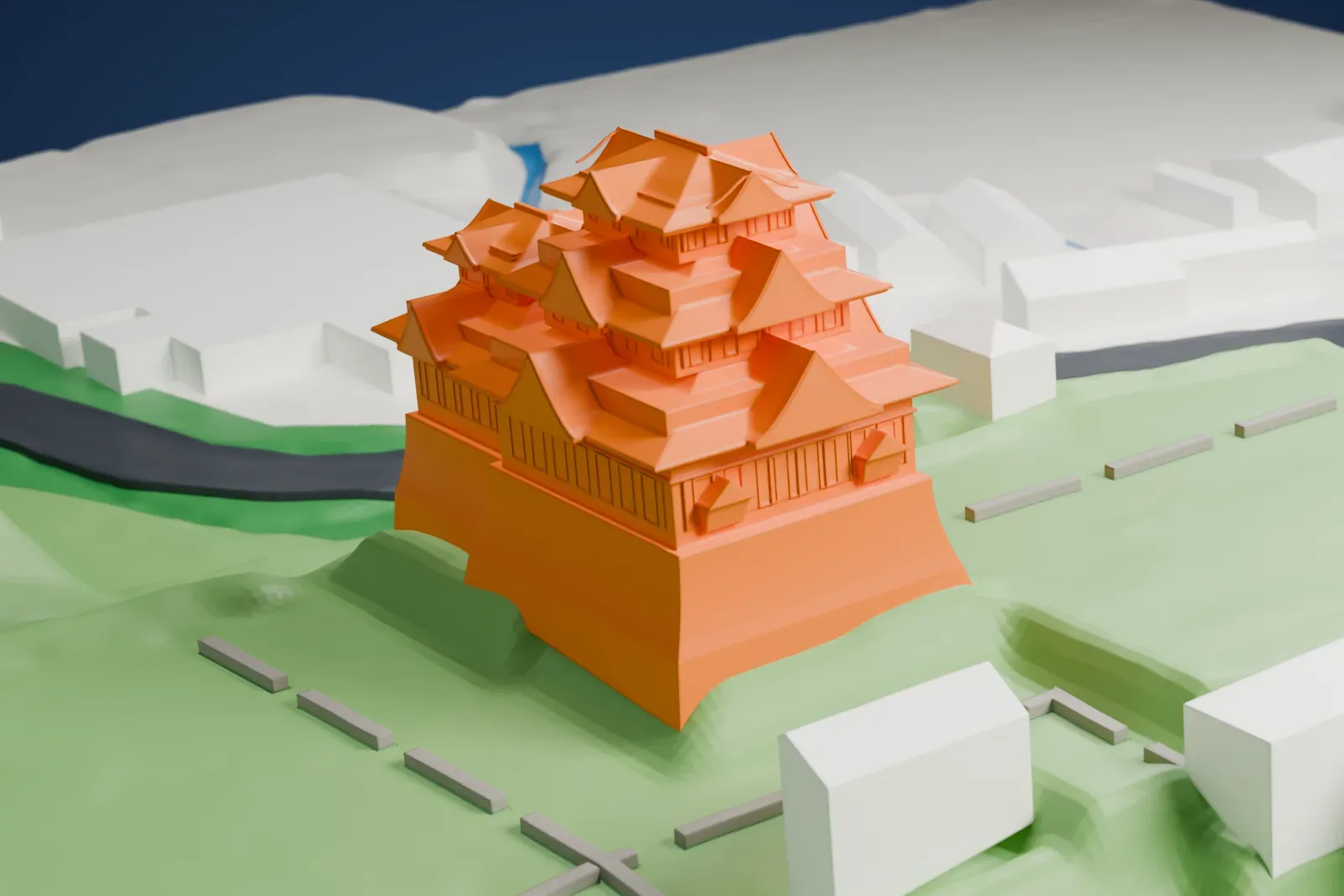
Kumamoto Castle in 3D
Kumamoto Castle appears in city models you make here; its design may still be protected, so it isn't offered as a separate download.
-
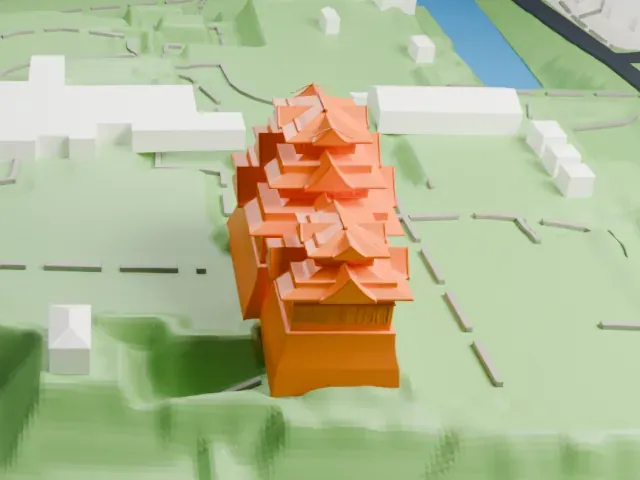 North
-
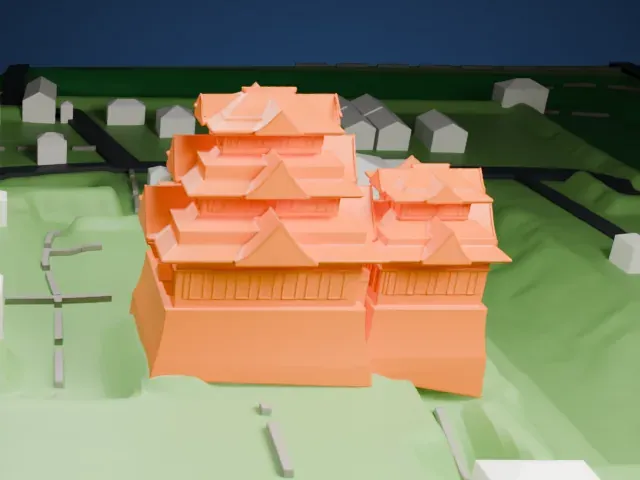 East
-
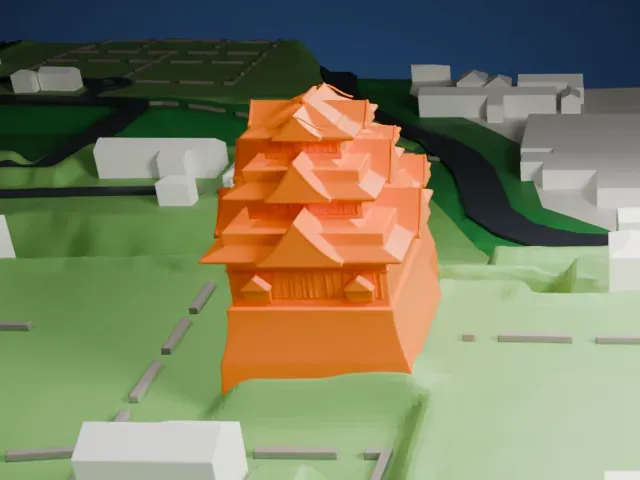 South
-
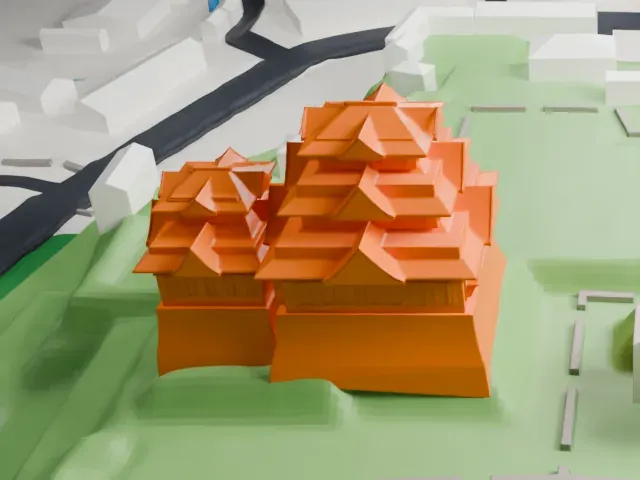 West
© OpenStreetMap contributors · Terrain in Japan: 出典:国土地理院 (GSI elevation data via Mapterhorn)
Copyright notice
The design of Kumamoto Castle may still be protected by copyright. It appears in the city models you make here, but it is not offered as a separate model.
- On a 160 mm print
- 12 mm
- Scale
- 1:3,750
12 mm tall on a 160 mm print
Make this print opens the generator on a 600 m square around the landmark. Buildings print at close to true scale, so the landmark grows with the print size.
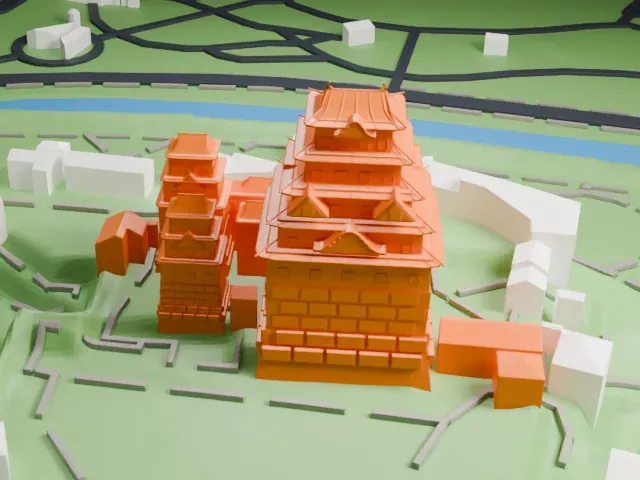
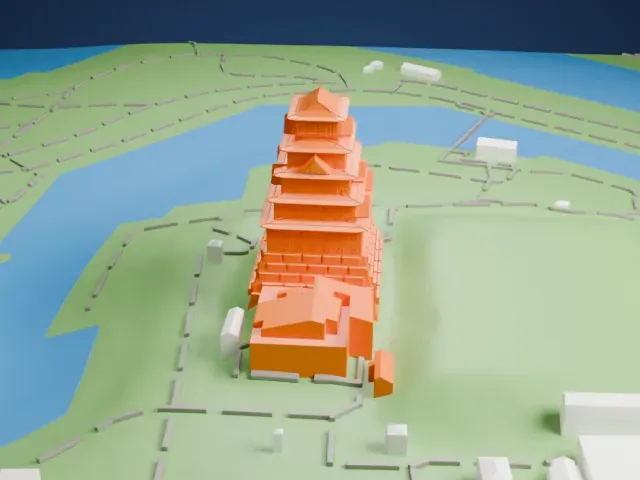
- Stacked roofs and gables
Each keep is a stack of overhanging roofs and gables, with tiny ridge ornaments at the top. Layers of 0.12 to 0.16 mm keep the eaves crisp, and printing slowly helps the small tips.
- Flared stone bases
A curved, flaring base slopes out beneath each keep. A larger print size keeps the curve smooth, and Full detail keeps every modeled feature.
- One piece with the ground
Kumamoto Castle is joined to the ground in the exported file, and the four-side check found no floating parts, so nothing needs gluing.
- Pick the detail for your nozzle
In the Buildings settings, set Landmark detail to Print friendly to adapt thin parts and small details to the print scale. Full detail keeps every modeled feature, for larger prints or a finer nozzle.
- Colors
Buildings, roads, water and ground arrive as separate filament slots in the 3MF. Kumamoto Castle takes the building color.
- File format
You get a 3MF for Bambu Studio, OrcaSlicer or PrusaSlicer. Any of them can save it as STL if you need one.
About Kumamoto Castle
Kumamoto Castle (熊本城) is a Japanese castle on a hilltop in the Chūō-ku ward of Kumamoto, within Kumamoto Prefecture. The castle was large and heavily fortified, and it is counted among Japan's three premier castles, with Himeji Castle and Matsumoto Castle. The site goes back to 1467, when Ideta Hidenobu established fortifications there. Kanokogi Chikakazu expanded them in 1496, and Katō Kiyomasa received a transfer to the castle in 1588, when it was still in an early form.
Kiyomasa greatly enlarged the castle between 1601 and 1607, turning it into a complex that included 49 turrets, 29 smaller gates and 18 turret gates, and the Honmaru Goten Palace was completed in 1610. The complex spans roughly 1.6 kilometers (0.99 mi) east to west by 1.2 kilometers (0.75 mi) north to south, and the castle keep is 30.3 meters (99 ft) tall. Its curved stone walls, called musha-gaeshi, and its wooden overhangs were meant to keep attackers out.
In 1877, during the Satsuma Rebellion, the castle came under siege, and the keep and other parts burned; it held out against 19th-century weapons without falling. The keep is a reconstruction in concrete, built in 1960, and several ancillary wooden buildings survive from the original castle. Thirteen structures in the complex are designated Important Cultural Property. Restoration work between 1998 and 2008 saw most of the 17th-century structures rebuilt.
About this model
Kumamoto Castle is one of more than 5,500 landmark models in Mini Skyline. They are made with AI, and each one is checked in its real surroundings before release. Each model is written as code from public descriptions, plans, photographs and aerial views used only as references; no image or third-party model is copied into it. Everything around it is built from OpenStreetMap and Overture map data. Rights in the building itself, its name and any brands on it are not granted by Mini Skyline; clear them separately before you sell prints. If you would rather print the shape from map data, turn off Landmark models in the Buildings settings.
Mini Skyline is not affiliated with, or endorsed by, the owners of this building or its names and marks.
Keep exploring