3D print the Pagoda of Fogong Temple
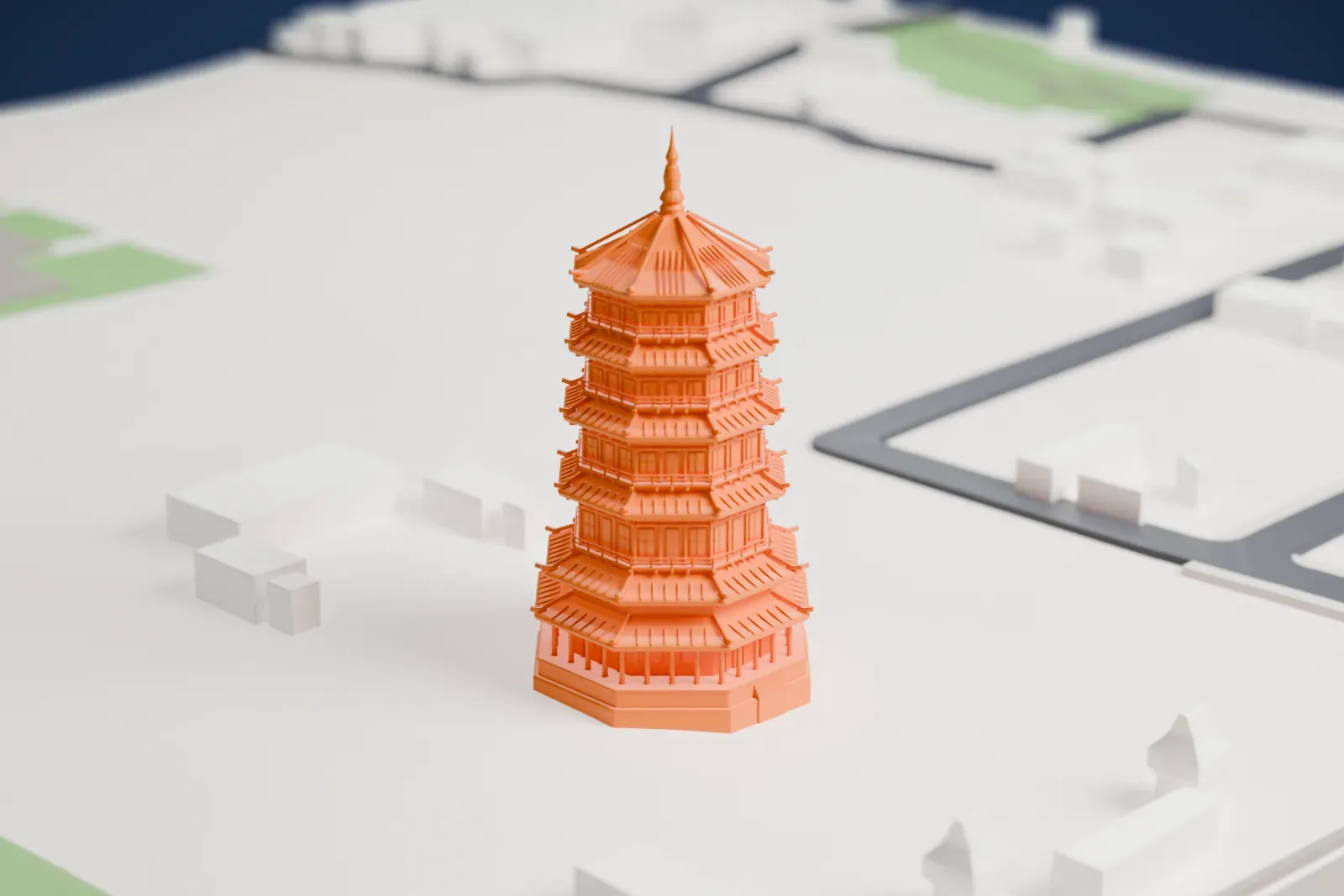
A free, printable model of the Pagoda of Fogong Temple, with its tiers of eaves and slim spire and the open grounds and buildings around it, generated from real map data in your browser.
-
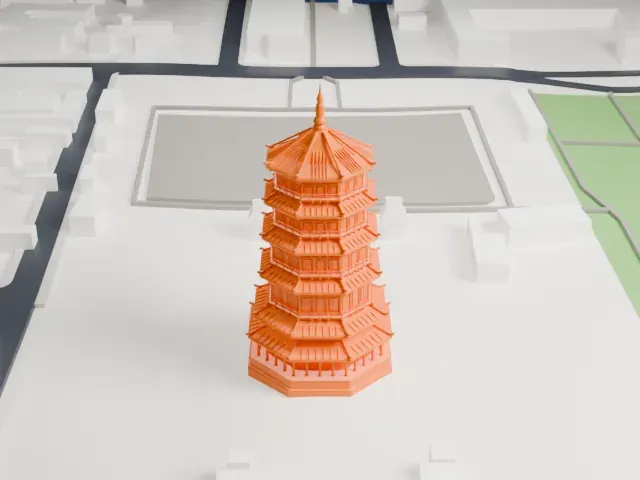 North
-
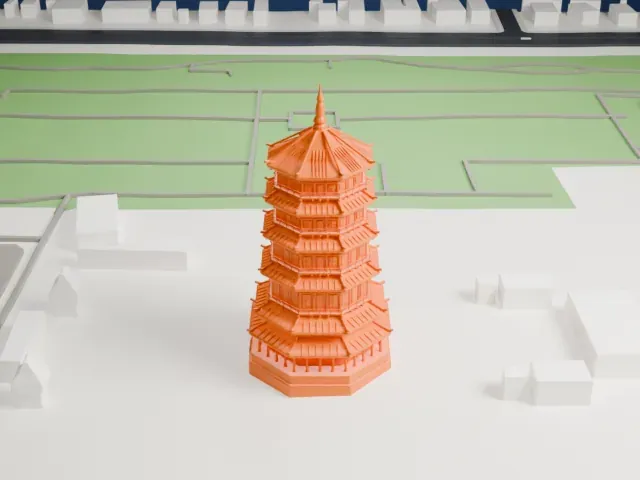 East
-
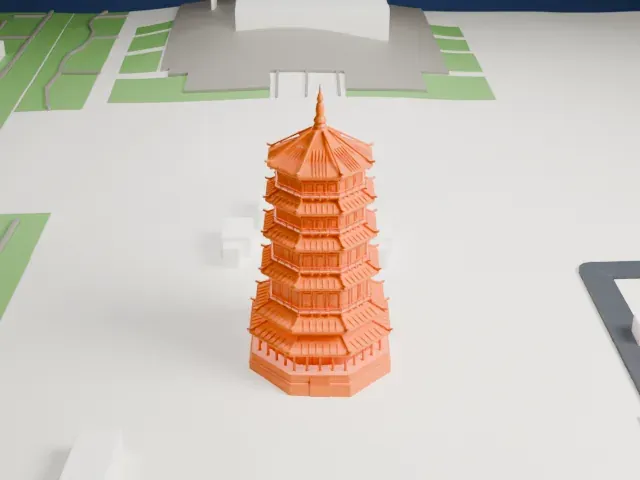 South
-
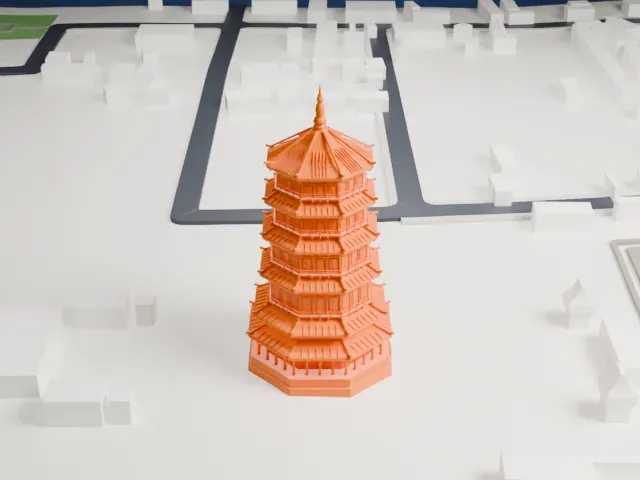 West
The model you print
Pagoda of Fogong Temple in 3D
The landmark on its own, at its size on a 160 mm print. Print friendly thickens thin parts for a 0.4 mm nozzle; Full detail keeps every part.
- Real height
- 67 m
- On a 160 mm print
- 19 mm
- Scale
- 1:3,750
67 m of the Pagoda of Fogong Temple, 19 mm on your shelf
Make this print opens the generator on a 600 m square around the landmark. Buildings print at close to true scale, so the landmark grows with the print size.
- Tiers of thin eaves
Each story has a projecting roof with small brackets and railings. These overhangs are the most delicate part: use Full detail on a larger print, or Print friendly to adapt them to the print scale.
- Slim spire at the top
The steeple tapers to a very fine point. Print the upper section slowly with good cooling, and use a 0.12 mm layer height to keep the tip crisp.
- One piece with the ground
The Pagoda of Fogong Temple is joined to the ground in the exported file, and the four-side check found no floating parts, so nothing needs gluing.
- Pick the detail for your nozzle
In the Buildings settings, set Landmark detail to Print friendly to adapt thin parts and small details to the print scale. Full detail keeps every modeled feature, for larger prints or a finer nozzle.
- Colors
Buildings, roads, water and ground arrive as separate filament slots in the 3MF. The Pagoda of Fogong Temple takes the building color.
- File format
You get a 3MF for Bambu Studio, OrcaSlicer or PrusaSlicer. Any of them can save it as STL if you need one.
About the Pagoda of Fogong Temple
The Sakyamuni Pagoda of Fogong Temple stands in Ying County, Shanxi province, China, and is also called the Wooden Pagoda of Ying County. It was constructed in 1056 under the Khitan-led Liao dynasty, and it was renovated and expanded in 1195 under the Jin dynasty. Emperor Daozong of Liao built it on ground once occupied by the house of his grandmother's family.
The pagoda rises from a stone platform 4 m (13 ft) tall and has a steeple 10 m (33 ft) tall. Its total height is 67.31 m (220.83 ft), and no fully wooden pagoda that survives in China is older. It has survived several large earthquakes over the centuries, and its fame led to the generic nickname Muta, meaning Timber Pagoda.
It was built entirely without nails or iron bars, held together by the interlocking of its wooden parts, and it combines 54 kinds of bracket arms, more than any other structure of the Liao dynasty. From outside it appears to have five stories, but the interior reveals nine in all. The pagoda takes its name from the statue of the Buddha Sakyamuni that occupies the center of the first floor.
About this model
The Pagoda of Fogong Temple is one of more than 6,500 landmark models in Mini Skyline. They are made with AI, and each one is checked in its real surroundings before release. Each model is written as code from public descriptions, plans, photographs and aerial views used only as references; no image or third-party model is copied into it. Everything around it is built from OpenStreetMap and Overture map data. Rights in the building itself, its name and any brands on it are not granted by Mini Skyline; clear them separately before you sell prints. If you would rather print the shape from map data, turn off Landmark models in the Buildings settings.
Mini Skyline is not affiliated with, or endorsed by, the owners of this building or its names and marks.
Keep exploring