3D print the Royal Albert Hall
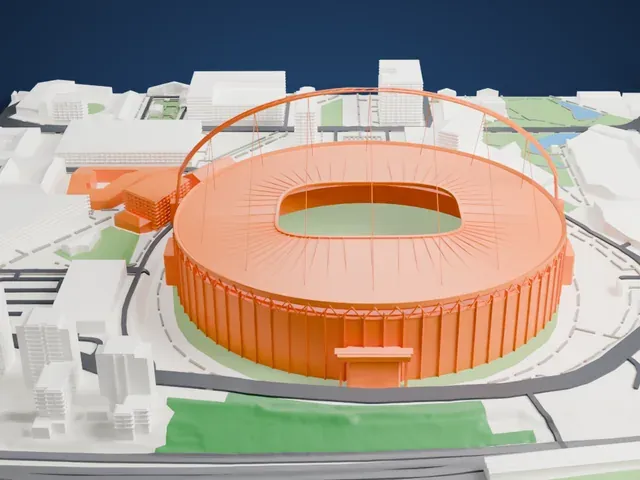
A free, printable model of the Royal Albert Hall, its domed drum and porches, and the streets and park edge around it in London, generated from real map data in your browser.
-
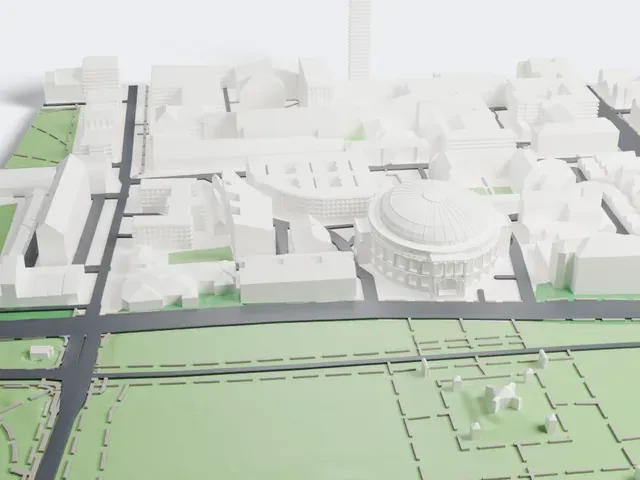 North
-
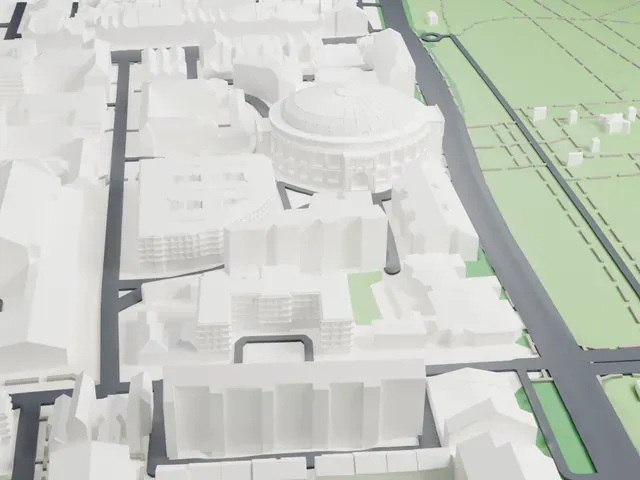 East
-
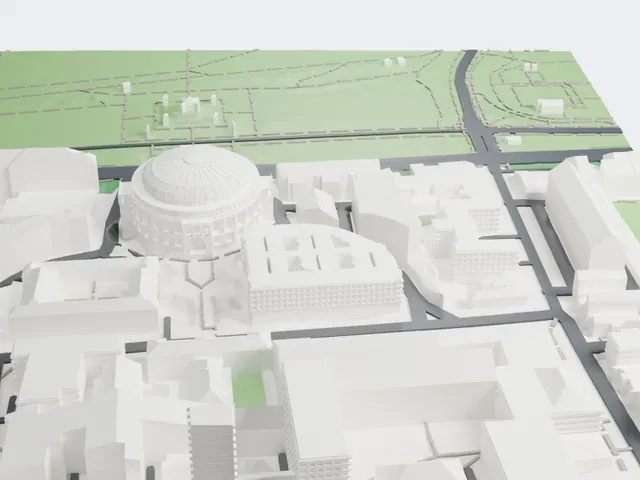 South
-
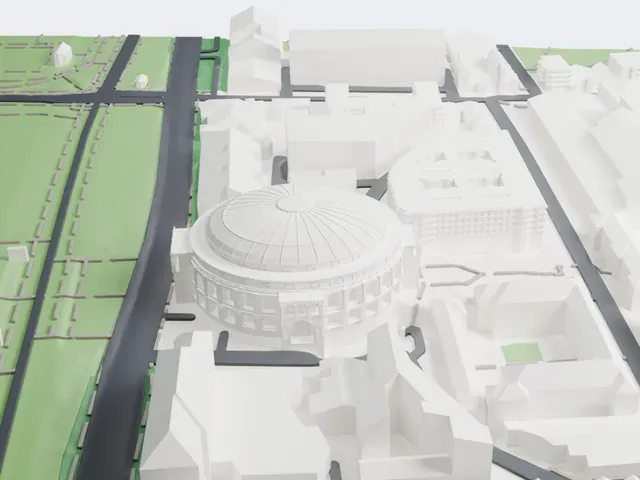 West
The model you print
Royal Albert Hall in 3D
The landmark on its own, at its size on a 160 mm print. Print friendly thickens thin parts for a 0.4 mm nozzle; Full detail keeps every part.
- On a 160 mm print
- 13 mm
- Scale
- 1:3,750
13 mm tall on a 160 mm print
Make this print opens the generator on a 600 m square around the landmark. Buildings print at close to true scale, so the landmark grows with the print size.
- Ribbed glazed dome
The dome carries fine radial ribs up to a small central cap. Layers of 0.12 to 0.16 mm keep the ribs crisp, and a slower print speed helps the curve.
- Slim columns and arches
Thin columns and rows of arches circle the drum, and projecting porches break the outline. Print friendly adapts the slim columns to your scale; Full detail keeps them on a larger print.
- One piece with the ground
The Royal Albert Hall is joined to the ground in the exported file, and the four-side check found no floating parts, so nothing needs gluing.
- Pick the detail for your nozzle
In the Buildings settings, set Landmark detail to Print friendly to adapt thin parts and small details to the print scale. Full detail keeps every modeled feature, for larger prints or a finer nozzle.
- Colors
Buildings, roads, water and ground arrive as separate filament slots in the 3MF. The Royal Albert Hall takes the building color.
- File format
You get a 3MF for Bambu Studio, OrcaSlicer or PrusaSlicer. Any of them can save it as STL if you need one.
About the Royal Albert Hall
Standing at the northern edge of South Kensington in London, England, the Royal Albert Hall serves as a concert venue seating 5,272. Queen Victoria opened it in 1871. The hall is the practical half of a memorial to her husband, Prince Albert, and the decorative half is the Albert Memorial, which lies just north of it in Kensington Gardens. Victoria gave it Albert's name when she laid its foundation stone in 1867; it had been meant to be called Central Hall of Arts and Sciences.
Francis Fowke, a captain, and Henry Y. D. Scott, a major-general, both civil engineers of the Royal Engineers, designed the hall, and Lucas Brothers built it. Ancient amphitheaters strongly shaped the designers' approach. Its walls are mostly Fareham Red brick, decorated with blocks of terra cotta, and the glazed dome, designed by Rowland Mason Ordish, is made of wrought iron. The official opening ceremony took place on March 29, 1871.
The main auditorium hosts more than 390 shows a year, from classical, rock and pop concerts to ballet, opera, sports and awards ceremonies, and the BBC Proms concerts take place there every summer, as they have since 1941. A further 1,000 events a year take place in the other spaces. Acoustic problems became apparent right away; in 1969 large acoustic diffusing discs nicknamed "mushrooms" or "flying saucers" were hung below the ceiling.
About this model
The Royal Albert Hall is one of more than 5,500 landmark models in Mini Skyline. They are made with AI, and each one is checked in its real surroundings before release. Each model is written as code from public descriptions, plans, photographs and aerial views used only as references; no image or third-party model is copied into it. Everything around it is built from OpenStreetMap and Overture map data. Rights in the building itself, its name and any brands on it are not granted by Mini Skyline; clear them separately before you sell prints. If you would rather print the shape from map data, turn off Landmark models in the Buildings settings.
Mini Skyline is not affiliated with, or endorsed by, the owners of this building or its names and marks.
Same skyline