3D print Santa Pudenziana
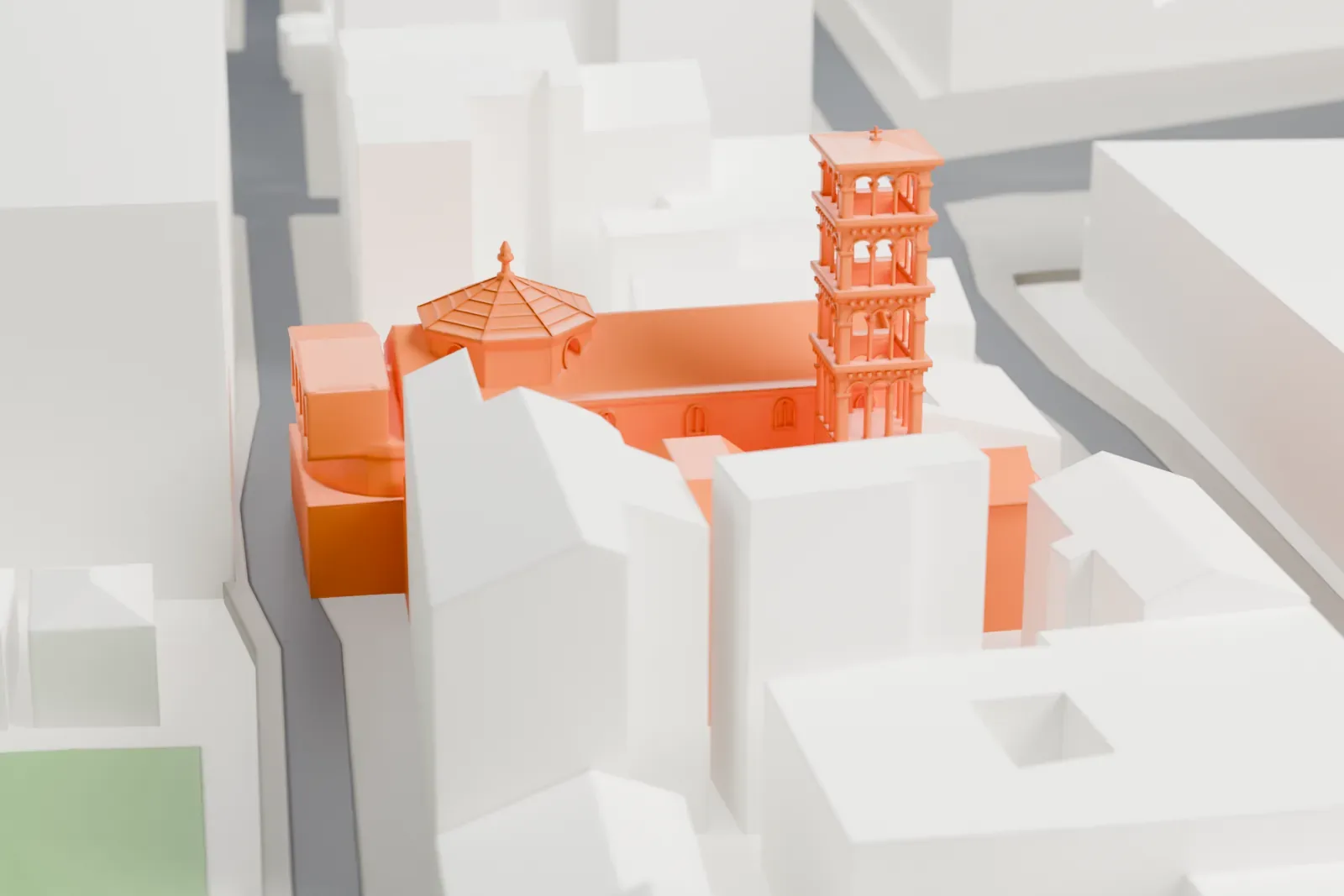
A free, printable 3D model of Santa Pudenziana in Rome, with the surrounding streets and buildings, generated from real map data in your browser.
-
 North
-
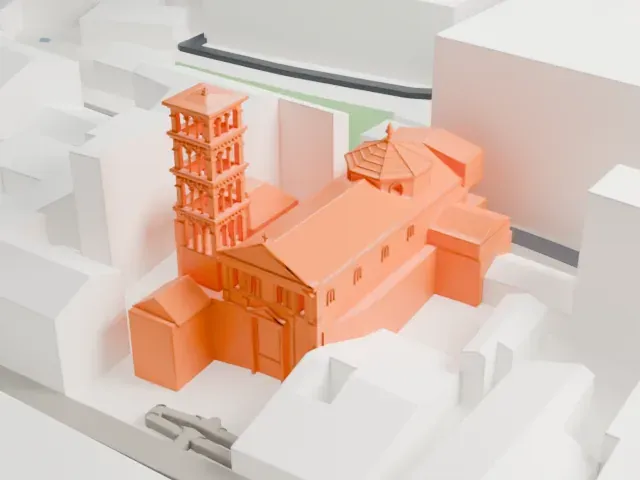 East
-
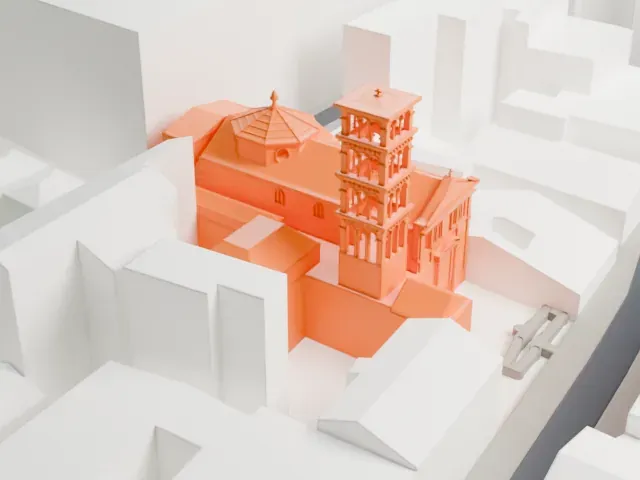 South
-
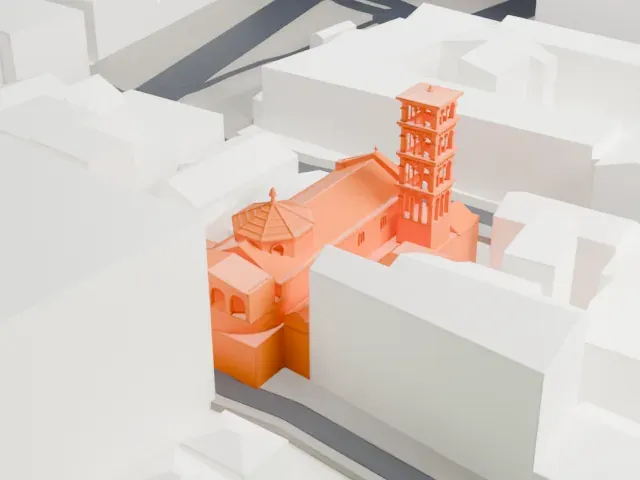 West
- On a 160 mm print
- 10 mm
- Scale
- 1:3,750
10 mm tall on a 160 mm print
Make this print opens the generator on a 600 m square around the landmark. Buildings print at close to true scale, so the landmark grows with the print size.
- Print size for the outline
A larger print gives the church's outline and roofline more room; Print friendly adapts small parts to the print scale, and Full detail keeps every modeled feature.
- Layers for the facade
Use 0.12 to 0.16 mm layers so the facade and roof edges stay crisp at the default size.
- One piece with the ground
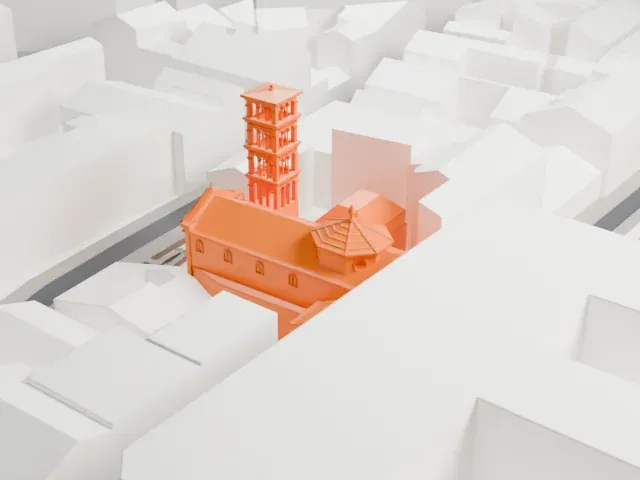
Santa Pudenziana is joined to the ground in the exported file, and the four-side check found no floating parts, so nothing needs gluing.
- Pick the detail for your nozzle
In the Buildings settings, set Landmark detail to Print friendly to adapt thin parts and small details to the print scale. Full detail keeps every modeled feature, for larger prints or a finer nozzle.
- Colors
Buildings, roads, water and ground arrive as separate filament slots in the 3MF. Santa Pudenziana takes the building color.
- File format
You get a 3MF for Bambu Studio, OrcaSlicer or PrusaSlicer. Any of them can save it as STL if you need one.
About Santa Pudenziana
Santa Pudenziana counts as the oldest of Rome's Roman Catholic basilicas, raised in the fourth century. A shrine on the site goes back to the second century; it honors Saint Pudentiana, whose sister Praxedes was martyred and whose father was Saint Pudens. The church is one of Rome's national churches for the Philippines, and the building is linked with the Filipino peoples in devotion and culture. Locals also call it Basilica della Pudenziana al Viminale.
A second-century dwelling stood under the church, which was probably put up while Pius I was pope, in 140–55, and reused part of a Roman bath complex; that masonry remains visible in the apse. The pope lived here until 313, when Constantine the Great made Christianity legal and gave the Lateran Palace instead. It became a Christian basilica during the fourth century, under Pope Siricius, and the acts of a synod in 499 name it the Titulus Pudentis.
Steps from the nineteenth century and wrought-iron gates lead down to the church, which sits below the modern street. In 1870 the facade was renewed; it includes a marble frieze taken from an eleventh-century doorway, and a Romanesque bell tower followed in the early thirteenth century. Francesco da Volterra's work of 1388 merged the three naves and introduced a dome. In the apse, a mosaic of the late fourth century—one of Rome's oldest Christian mosaics—shows Christ on a jeweled throne, wearing a golden toga, with apostles around him.
About this model
Santa Pudenziana is one of more than 4,400 landmark models in Mini Skyline. They are made with AI, and each one is checked from four sides in its real surroundings before release. Everything around it is built from OpenStreetMap and Overture map data. If you would rather print the shape from map data, turn off Landmark models in the Buildings settings.
Same skyline