3D print Castel Sant'Angelo
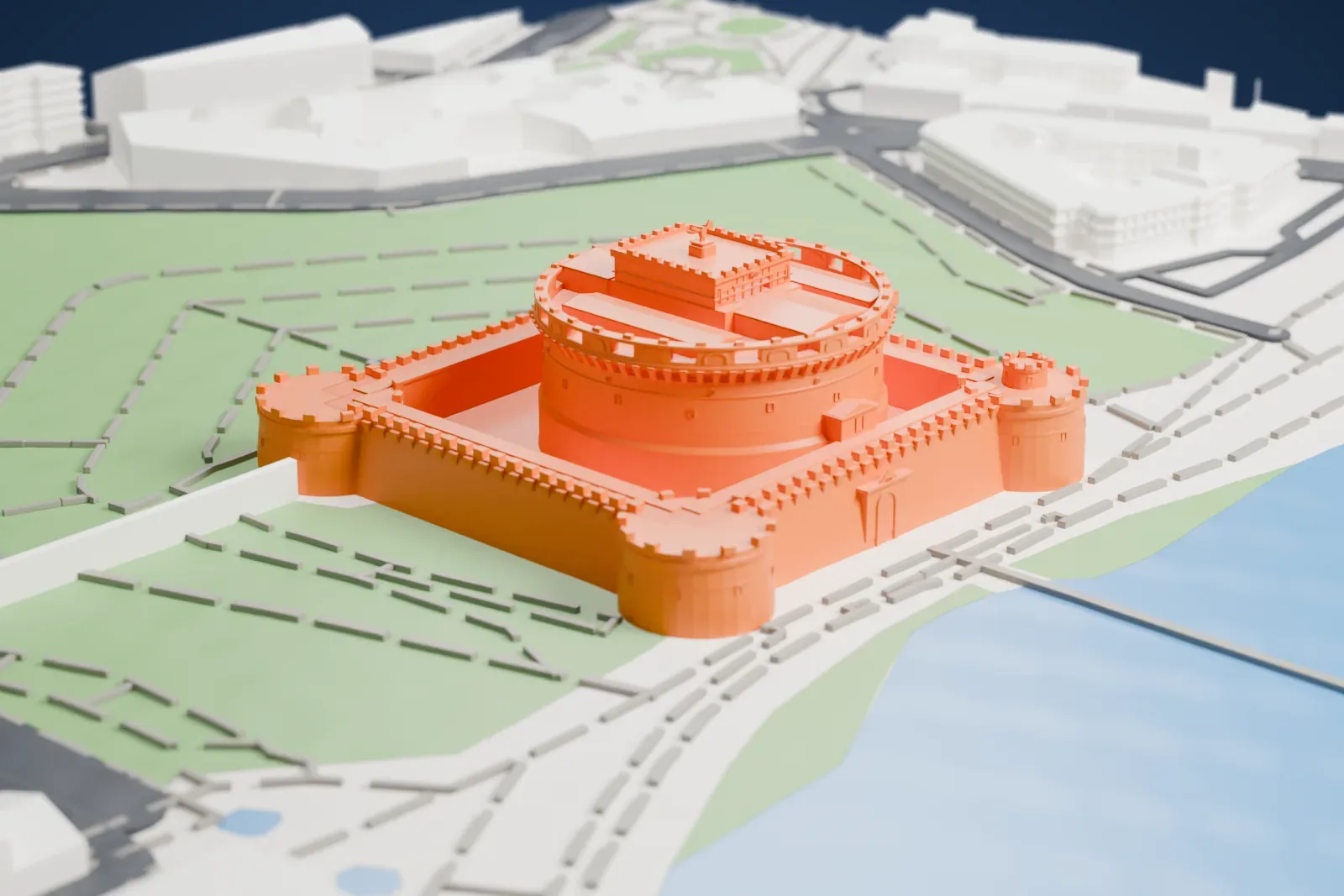
A free, printable model of Castel Sant'Angelo, with its round drum, corner bastions, the river beside it and the parkland around it, generated from real map data in your browser.
-
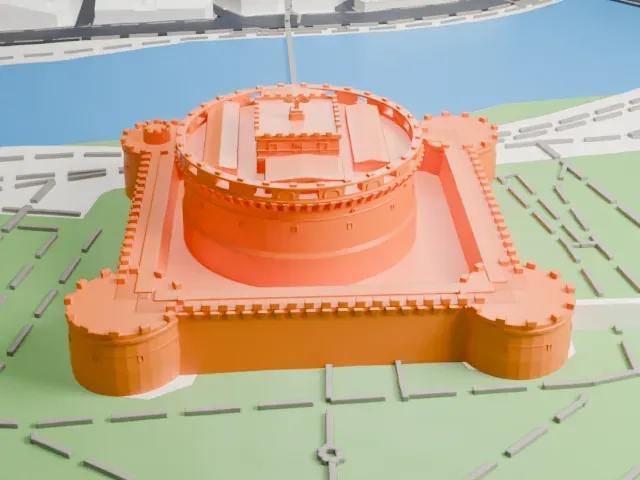 North
-
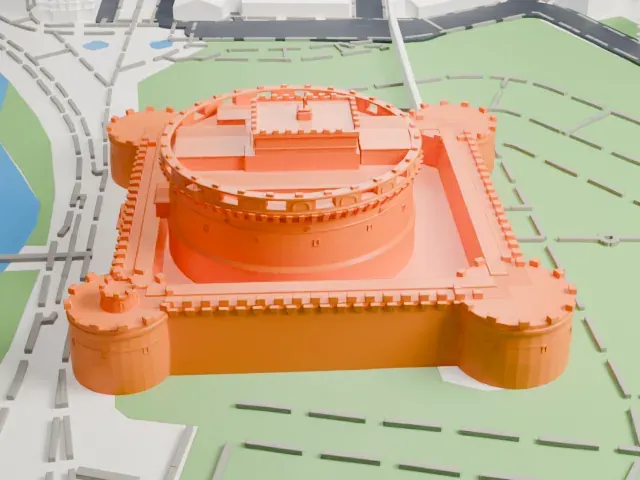 East
-
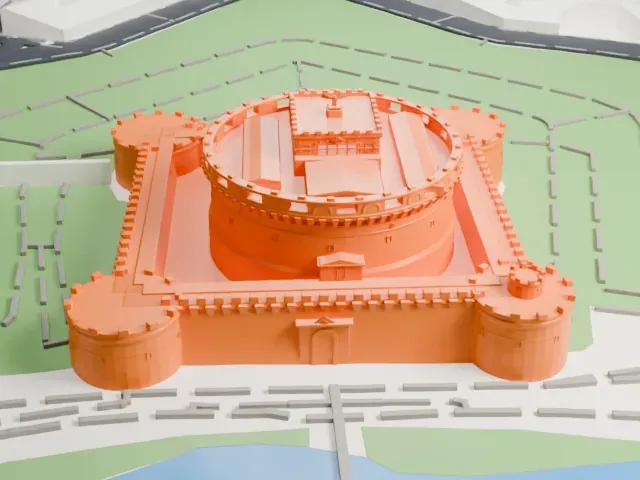 South
-
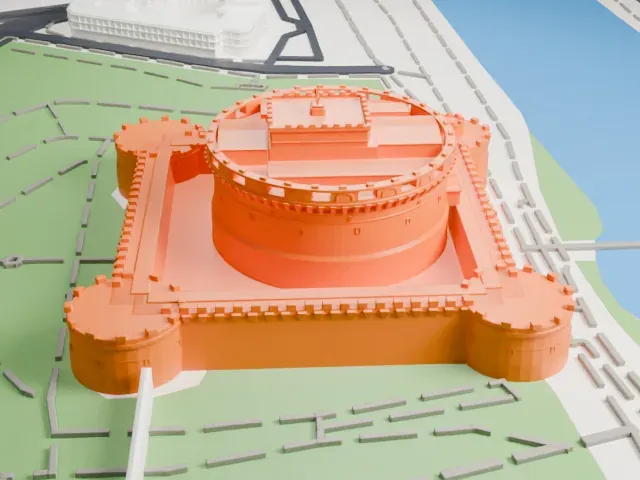 West
The model you print
Castel Sant'Angelo in 3D
The landmark on its own, at its size on a 160 mm print. Print friendly thickens thin parts for a 0.4 mm nozzle; Full detail keeps every part.
- On a 160 mm print
- 14 mm
- Scale
- 1:3,750
14 mm tall on a 160 mm print
Make this print opens the generator on a 600 m square around the landmark. Buildings print at close to true scale, so the landmark grows with the print size.
- Battlements and corner bastions
Small battlements and turrets crown the walls and the four round corner bastions. Print friendly adapts them to the print scale; Full detail keeps every one, which suits a larger print or a fine nozzle.
- Fine detail on the drum
The round drum carries thin bands and a busy roof with small buildings on top. A bigger print size keeps more of them, and layers of 0.12 to 0.16 mm keep the edges crisp.
- One piece with the ground
Castel Sant'Angelo is joined to the ground in the exported file, and the four-side check found no floating parts, so nothing needs gluing.
- Pick the detail for your nozzle
In the Buildings settings, set Landmark detail to Print friendly to adapt thin parts and small details to the print scale. Full detail keeps every modeled feature, for larger prints or a finer nozzle.
- Colors
Buildings, roads, water and ground arrive as separate filament slots in the 3MF. Castel Sant'Angelo takes the building color.
- File format
You get a 3MF for Bambu Studio, OrcaSlicer or PrusaSlicer. Any of them can save it as STL if you need one.
About Castel Sant'Angelo
Castel Sant'Angelo, also called the Mausoleum of Hadrian, is a tall cylindrical rotunda in Parco Adriano in Rome, Italy. Emperor Hadrian ordered it built as a tomb for himself and his family. It went up on the Tiber's right bank between 134 and 139 AD. The original mausoleum was a decorated cylinder topped with a garden and a golden quadriga.
Later on, the popes made use of it as a stronghold and as a castle devoted to Saint Michael the Archangel. Pope Nicholas III joined it to St Peter's Basilica with a fortified, covered corridor known as the Passetto di Borgo. The popes began converting the structure into a castle in the 14th century. A legend says the Archangel Michael appeared on top of the mausoleum and sheathed his sword, marking the end of a plague in 590. In 1753 a bronze statue of Saint Michael by Peter Anton von Verschaffelt, a Flemish sculptor, replaced an earlier marble statue.
The Papal State also used the castle as a prison, and Giordano Bruno spent six years locked up there. The third act of Puccini's 1900 opera Tosca is set at the castle. At one time it was the tallest building in Rome. After it was decommissioned in 1901, it became a museum under the name Museo Nazionale di Castel Sant'Angelo.
About this model
Castel Sant'Angelo is one of more than 5,500 landmark models in Mini Skyline. They are made with AI, and each one is checked in its real surroundings before release. Each model is written as code from public descriptions, plans, photographs and aerial views used only as references; no image or third-party model is copied into it. Everything around it is built from OpenStreetMap and Overture map data. Rights in the building itself, its name and any brands on it are not granted by Mini Skyline; clear them separately before you sell prints. If you would rather print the shape from map data, turn off Landmark models in the Buildings settings.
Mini Skyline is not affiliated with, or endorsed by, the owners of this building or its names and marks.
Same skyline