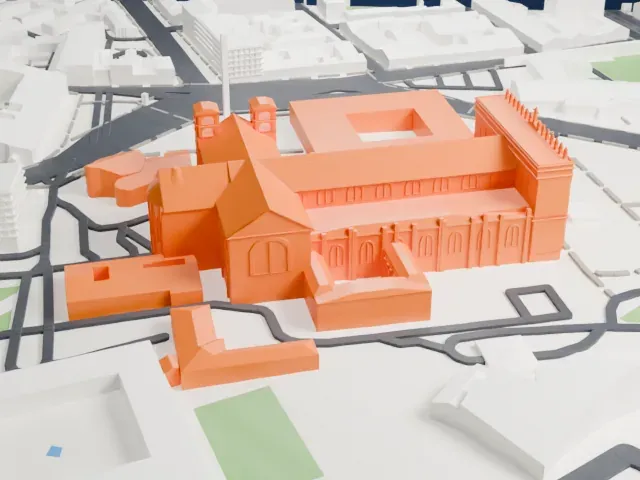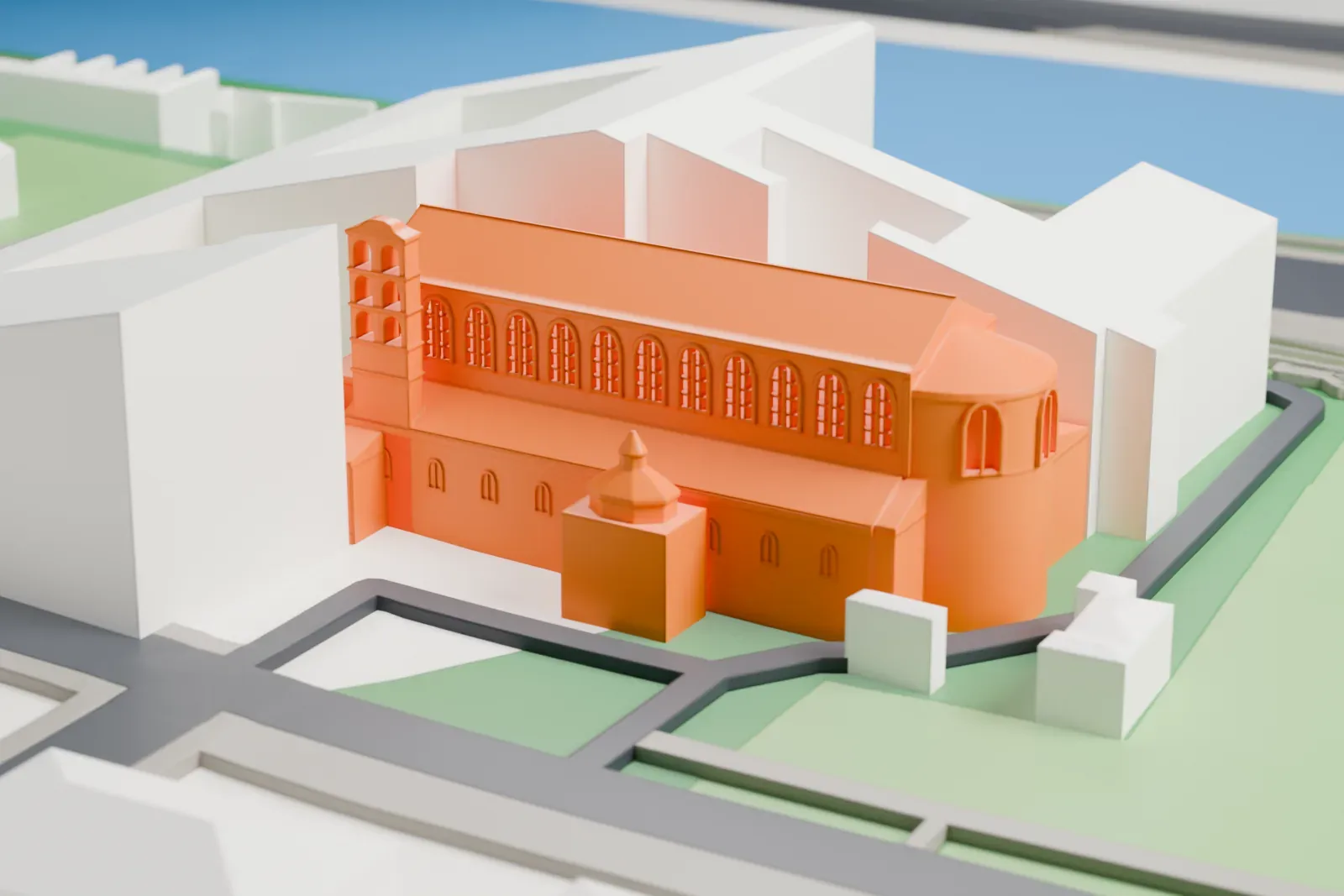
3D print the Santa Sabina
A free, printable model of Santa Sabina and the Aventine Hill around it, generated from real map data in your browser.
-
 North
-
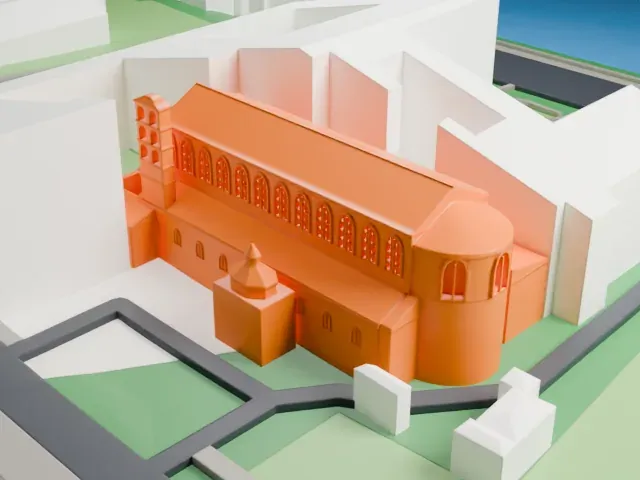 East
-
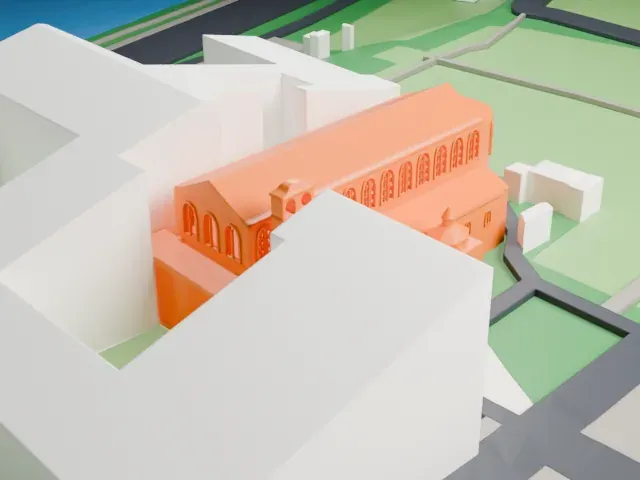 South
-
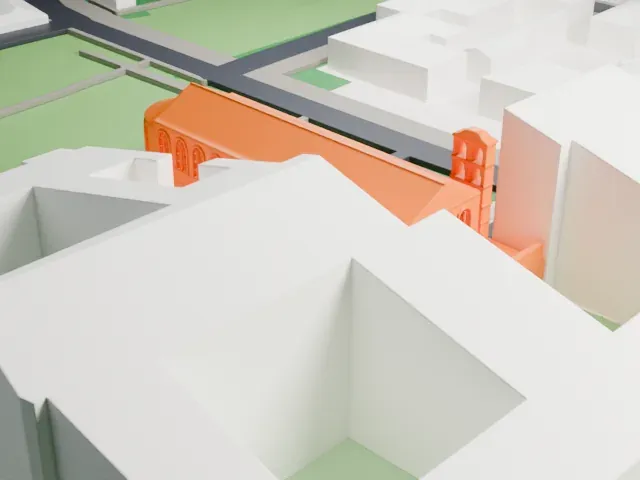 West
- On a 160 mm print
- 7 mm
- Scale
- 1:3,750
7 mm tall on a 160 mm print
Make this print opens the generator on a 600 m square around the landmark. Buildings print at close to true scale, so the landmark grows with the print size.
- Nave roof and bell tower
A long church like this reads through its nave roof and bell tower. Print it larger to keep the roof edges and the tower sharp, or use Full detail, with layers at 0.12–0.16 mm.
- One piece with the ground
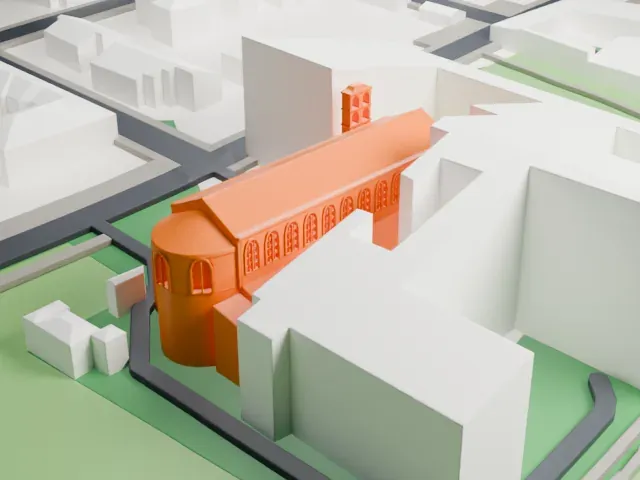
The Santa Sabina is joined to the ground in the exported file, and the four-side check found no floating parts, so nothing needs gluing.
- Pick the detail for your nozzle
In the Buildings settings, set Landmark detail to Print friendly to adapt thin parts and small details to the print scale. Full detail keeps every modeled feature, for larger prints or a finer nozzle.
- Colors
Buildings, roads, water and ground arrive as separate filament slots in the 3MF. The Santa Sabina takes the building color.
- File format
You get a 3MF for Bambu Studio, OrcaSlicer or PrusaSlicer. Any of them can save it as STL if you need one.
About the Santa Sabina
Santa Sabina stands on the Aventine Hill in Rome. It is a titular minor basilica; for the Dominicans, formally the Order of Preachers, it serves as mother church. Peter of Illyria, a Dalmatian priest, put it up in 422–432, close to a temple of Juno. Among Rome's churches it is the oldest that still keeps its original plan: a colonnaded rectangle ending in an apse, with its early architectural character intact.
The church's cypress doors, carved between AD 430 and 432, carry biblical scenes and are among its best-known features. Eighteen panels survive, and the most famous is the earliest known image of the crucifixion put on public display, showing Christ between the two thieves. Inside, the nave colonnade reuses twenty-four Proconnesian marble columns from the Temple of Juno, whose Corinthian capitals and bases match; a framed hole in the floor reveals an older Roman temple column beneath.
Most of the brickwork is left unrendered, and the windows are selenite rather than glass, so the building looks much as it did in the fifth century. The campanile was first put up in the tenth century and rebuilt in the Baroque style in the seventeenth. Antonio Muñoz restored the church's plain medieval appearance in 1914–1919, and P. Berthier finished the restoration in 1936–1938.
About this model
The Santa Sabina is one of more than 4,400 landmark models in Mini Skyline. They are made with AI, and each one is checked from four sides in its real surroundings before release. Everything around it is built from OpenStreetMap and Overture map data. If you would rather print the shape from map data, turn off Landmark models in the Buildings settings.
Same skyline