3D print St. Thomas More Church
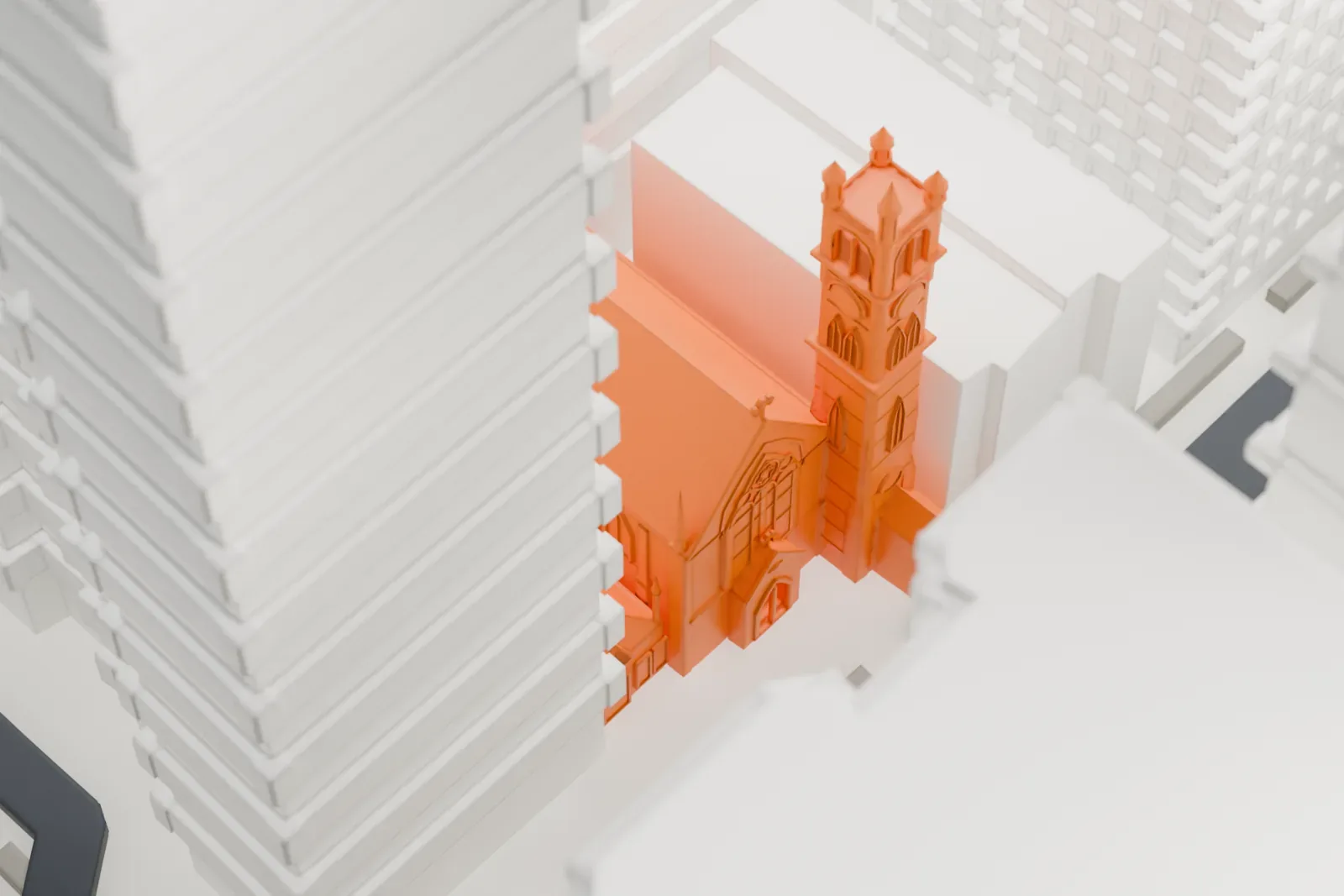
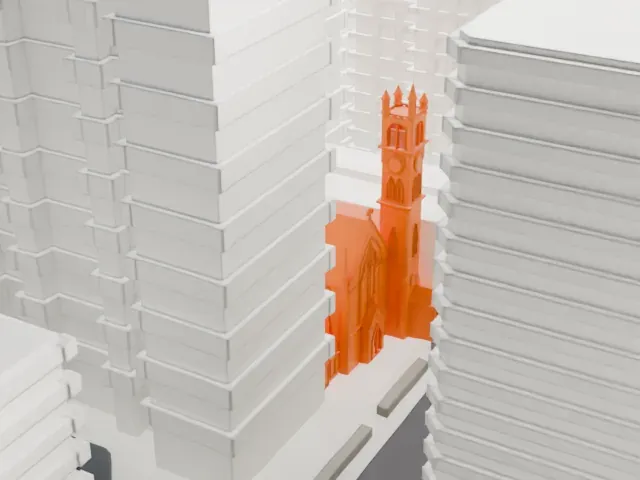
A free, printable model of St. Thomas More Church, a gabled church with a tall square tower, tucked among much taller buildings, generated from real map data in your browser.
-
 North
-
 East
-
 South
-
 West
The model you print
St. Thomas More Church in 3D
The landmark on its own, at its size on a 160 mm print. Print friendly thickens thin parts for a 0.4 mm nozzle; Full detail keeps every part.
- On a 160 mm print
- 11 mm
- Scale
- 1:3,750
11 mm tall on a 160 mm print
Make this print opens the generator on a 600 m square around the landmark. Buildings print at close to true scale, so the landmark grows with the print size.
- Slender tower with pinnacles
The square tower and its pinnacles are the thinnest parts of this model. Print slowly with cooling, and use 0.12-0.16 mm layers; a larger print helps the pinnacles hold their shape.
- One piece with the ground
St. Thomas More Church is joined to the ground in the exported file, and the four-side check found no floating parts, so nothing needs gluing.
- Pick the detail for your nozzle
In the Buildings settings, set Landmark detail to Print friendly to adapt thin parts and small details to the print scale. Full detail keeps every modeled feature, for larger prints or a finer nozzle.
- Colors
Buildings, roads, water and ground arrive as separate filament slots in the 3MF. St. Thomas More Church takes the building color.
- File format
You get a 3MF for Bambu Studio, OrcaSlicer or PrusaSlicer. Any of them can save it as STL if you need one.
About St. Thomas More Church
St. Thomas More Church belongs to a Catholic church complex at 65 East 89th Street on Manhattan’s Upper East Side. The parish falls under the Archdiocese of New York. The complex includes the church of 1870, a single-cell chapel from 1879, a rectory from 1880 and a parish house from 1893.
Built for the Episcopal Church in 1870 under the name Chapel of the Beloved Disciple, it is Gothic Revival in style and uses sandstone from Nova Scotia. Hubert & Pirsson drew the designs. Only one church on the Upper East Side is older. Architectural historian Christopher Gray said it feels like an English country church, picturesque, with grass at the front and a square tower rising ahead of the sanctuary.
Andrew S. Dolkart, another architectural historian, says it copies Edward Buckton Lamb’s 1865 church, St. Martin’s in Gospel Oak, London, quite closely. He points to chamfered corners, a facade whose planes vary, and an asymmetric pinnacle atop the tower. Under various names the building has served three Christian denominations. It was sold in 1929 to Dutch Reformed congregants and in 1950 to the Catholic Church.
About this model
St. Thomas More Church is one of more than 5,500 landmark models in Mini Skyline. They are made with AI, and each one is checked in its real surroundings before release. Each model is written as code from public descriptions, plans, photographs and aerial views used only as references; no image or third-party model is copied into it. Everything around it is built from OpenStreetMap and Overture map data. Rights in the building itself, its name and any brands on it are not granted by Mini Skyline; clear them separately before you sell prints. If you would rather print the shape from map data, turn off Landmark models in the Buildings settings.
Mini Skyline is not affiliated with, or endorsed by, the owners of this building or its names and marks.
Same skyline