3D print the Monument to the Great Fire of London
A free, printable model of London's Monument to the Great Fire, a tall column rising among the surrounding city buildings, generated from real map data in your browser.
-
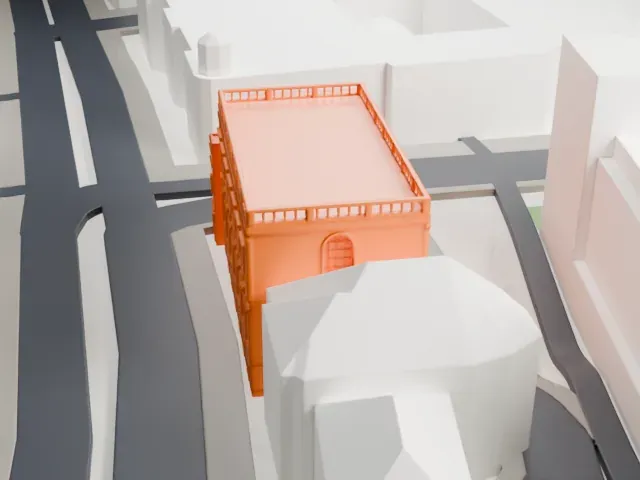
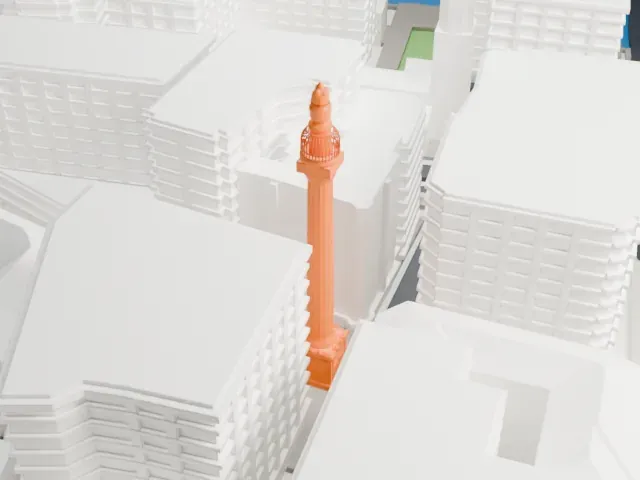 North
-
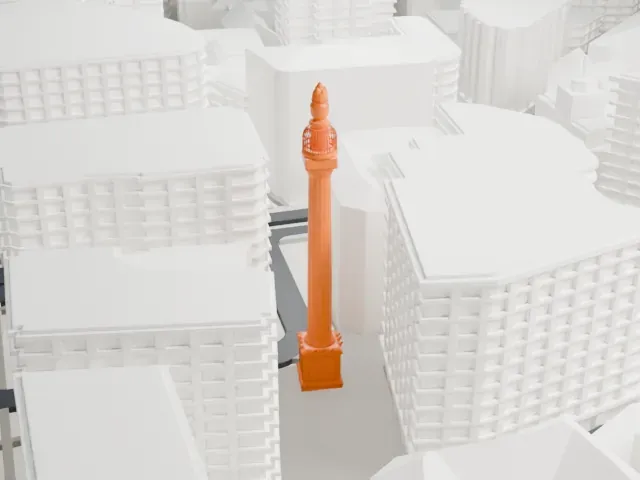 East
-
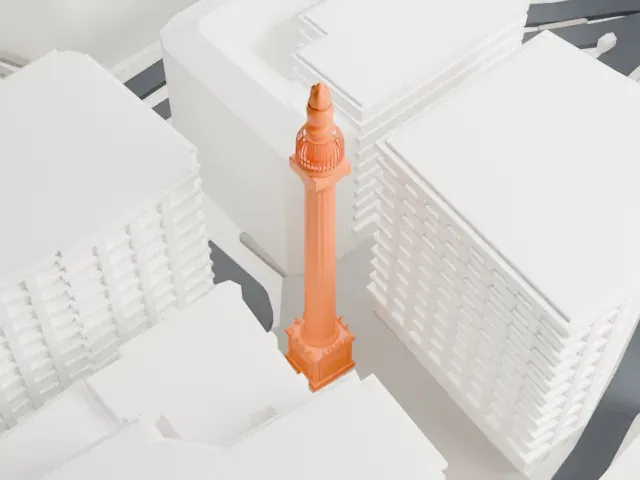 South
-
 West
The model you print
Monument to the Great Fire of London in 3D
The landmark on its own, at its size on a 160 mm print. Print friendly thickens thin parts for a 0.4 mm nozzle; Full detail keeps every part.
- Real height
- 62 m
- On a 160 mm print
- 17 mm
- Scale
- 1:3,750
62 m of the Monument to the Great Fire of London, 17 mm on your shelf
Make this print opens the generator on a 600 m square around the landmark. Buildings print at close to true scale, so the landmark grows with the print size.
- Slender shaft and urn finial
The tall, thin column ends in a small urn and a pointed tip, the most delicate part of the print. Print slowly with good cooling, and use a layer height of 0.12–0.16 mm to keep the top crisp.
- One piece with the ground
The Monument to the Great Fire of London is joined to the ground in the exported file, and the four-side check found no floating parts, so nothing needs gluing.
- Pick the detail for your nozzle
In the Buildings settings, set Landmark detail to Print friendly to adapt thin parts and small details to the print scale. Full detail keeps every modeled feature, for larger prints or a finer nozzle.
- Colors
Buildings, roads, water and ground arrive as separate filament slots in the 3MF. The Monument to the Great Fire of London takes the building color.
- File format
You get a 3MF for Bambu Studio, OrcaSlicer or PrusaSlicer. Any of them can save it as STL if you need one.
About the Monument to the Great Fire of London
The Monument, as most people call it, commemorates the Great Fire of London. It is a Doric column with a fluted shaft, close to London Bridge's northern end. It stands where Monument Street meets Fish Street Hill and measures 202 feet (61.6 m). Construction ran from 1671 to 1677, over the spot where St Margaret's church stood, the first church the Great Fire destroyed.
The column is made of Portland stone and crowned with a gilded urn of fire. Robert Hooke designed it. The Great Fire started on September 2, 1666 in Pudding Lane, 202 feet east of the column's position. A viewing platform near the top is reached by 311 steps up a narrow, winding staircase.
Latin inscriptions cover three sides of the base, and the west side carries a relief carved by Caius Gabriel Cibber that shows, in allegorical form, the City of London destroyed and then rebuilt. It holds Grade I listed status and is also a scheduled monument.
About this model
The Monument to the Great Fire of London is one of more than 6,500 landmark models in Mini Skyline. They are made with AI, and each one is checked in its real surroundings before release. Each model is written as code from public descriptions, plans, photographs and aerial views used only as references; no image or third-party model is copied into it. Everything around it is built from OpenStreetMap and Overture map data. Rights in the building itself, its name and any brands on it are not granted by Mini Skyline; clear them separately before you sell prints. If you would rather print the shape from map data, turn off Landmark models in the Buildings settings.
Mini Skyline is not affiliated with, or endorsed by, the owners of this building or its names and marks.
Same skyline