3D print the Nymphenburg Palace
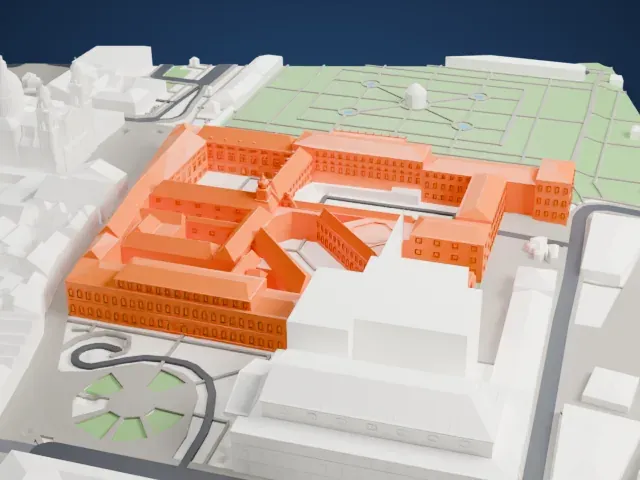
A free, printable 3D model of Nymphenburg Palace, a long, low palace, with the surrounding streets and buildings of Munich, generated from real map data in your browser.
-
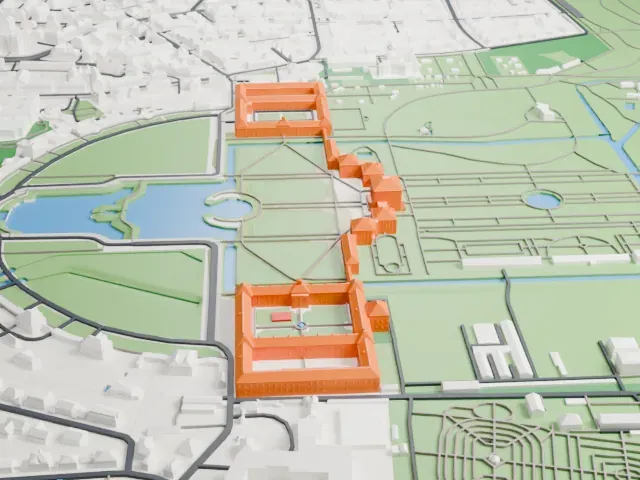 North
-
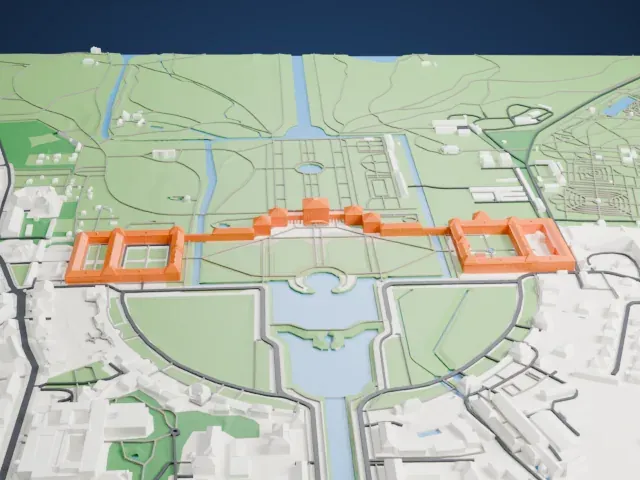 East
-
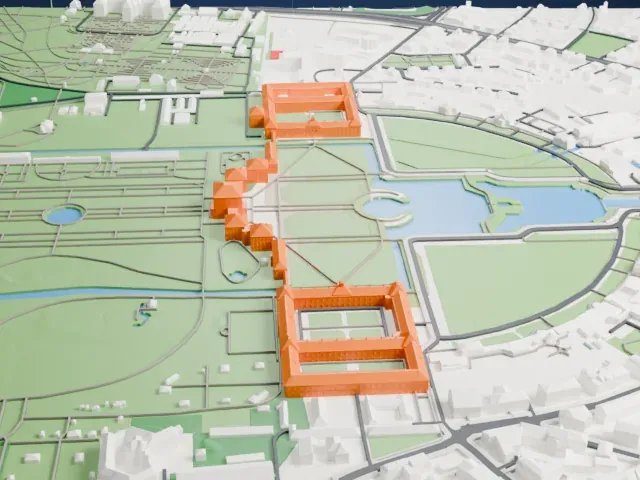 South
-
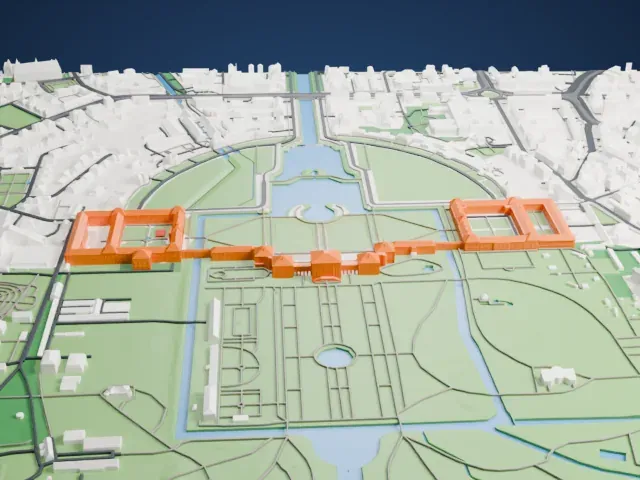 West
The model you print
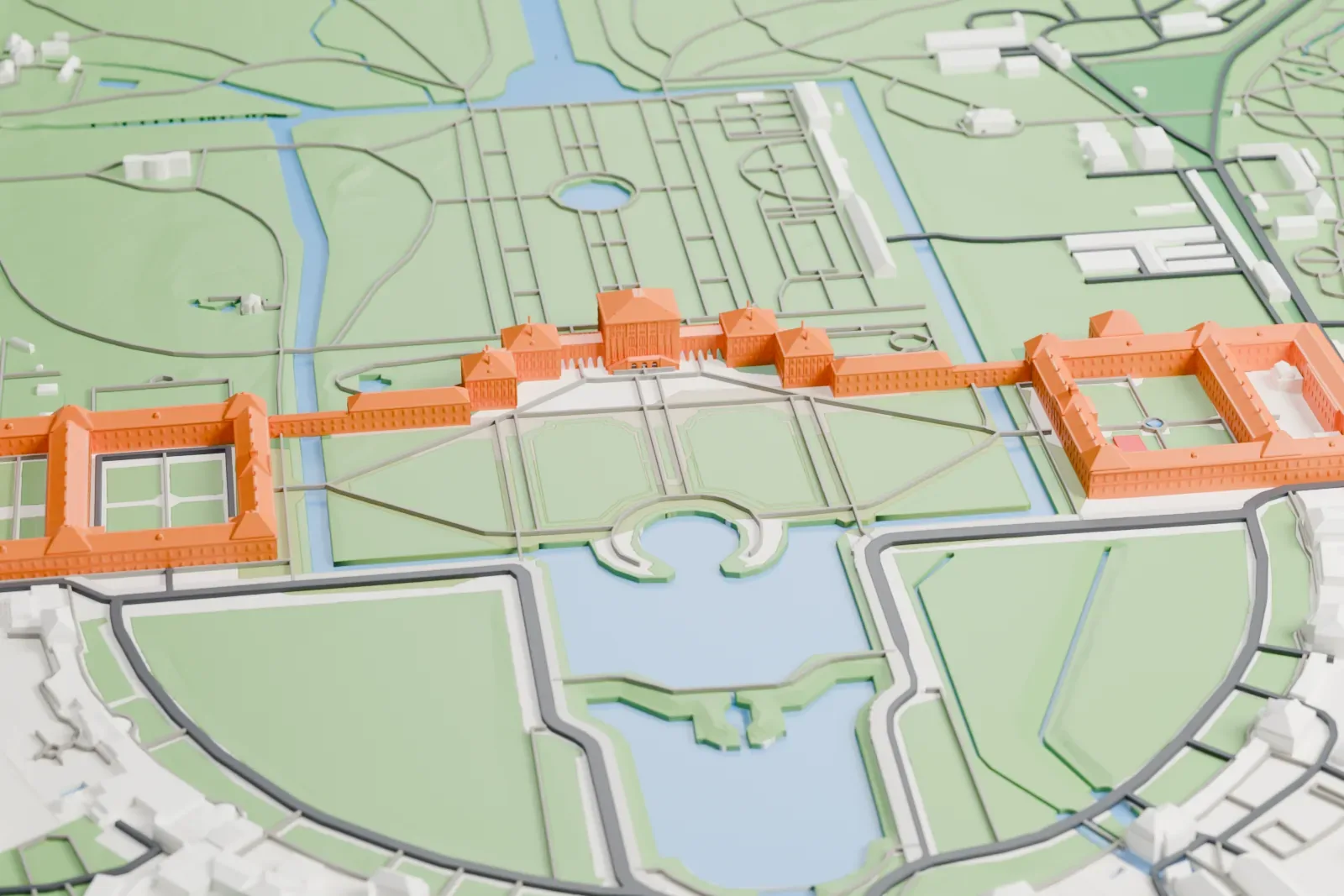
Nymphenburg Palace in 3D
The landmark on its own, at its size on a 160 mm print. Print friendly thickens thin parts for a 0.4 mm nozzle; Full detail keeps every part.
- On a 160 mm print
- 5 mm
- Scale
- 1:9,063
5 mm tall on a 160 mm print
Make this print opens the generator on a 1450 m square around the landmark. Buildings print at close to true scale, so the landmark grows with the print size.
- A long, shallow range
The palace is long and low in this model, so its outline carries the shape rather than any single detail. Print it larger if your plate allows, and use 0.12–0.16 mm layers for crisp edges.
- One piece with the ground
The Nymphenburg Palace is joined to the ground in the exported file, and the four-side check found no floating parts, so nothing needs gluing.
- Pick the detail for your nozzle
In the Buildings settings, set Landmark detail to Print friendly to adapt thin parts and small details to the print scale. Full detail keeps every modeled feature, for larger prints or a finer nozzle.
- Colors
Buildings, roads, water and ground arrive as separate filament slots in the 3MF. The Nymphenburg Palace takes the building color.
- File format
You get a 3MF for Bambu Studio, OrcaSlicer or PrusaSlicer. Any of them can save it as STL if you need one.
About the Nymphenburg Palace
Nymphenburg Palace, or Schloss Nymphenburg, is a Baroque palace in the west of Munich, in the district of Neuhausen-Nymphenburg, Bavaria, southern Germany. It served as the main summer home of the Wittelsbach rulers of Bavaria, and together with the palace park next to it counts among Europe's premier royal palaces. Across its front, measured on the north–south axis, it is wider than Versailles.
In 1664 Ferdinand Maria and his wife Henriette Adelaide of Savoy commissioned it, to designs by Agostino Barelli, an Italian architect, after their son Maximilian II Emanuel was born. Enrico Zuccalli replaced Barelli in 1674, the central pavilion was finished in 1675, and the palace used limestone from Kelheim. Maximilian Emanuel began a systematic extension in 1701; two pavilions went up at each end, by Enrico Zuccalli and Giovanni Antonio Viscardi, joined to the center by gallery wings. Joseph Effner gave the center pavilion a French Baroque facade with pilasters in 1716, the court stables followed in 1719, and the orangery at the north end was finished in 1758.
The palace stayed the favorite summer home of Bavaria's rulers for a long time. Max I Joseph, the king, died at Nymphenburg in 1825, and Ludwig II, his great-grandson, was born in the palace on August 25, 1845. Prince-Elector Maximilian III set up the Nymphenburg Porcelain Manufactory in 1747, and it is housed in one of the cavalier's lodges on the palace driveway. The palace is open to the public.
About this model
The Nymphenburg Palace is one of more than 6,500 landmark models in Mini Skyline. They are made with AI, and each one is checked in its real surroundings before release. Each model is written as code from public descriptions, plans, photographs and aerial views used only as references; no image or third-party model is copied into it. Everything around it is built from OpenStreetMap and Overture map data. Rights in the building itself, its name and any brands on it are not granted by Mini Skyline; clear them separately before you sell prints. If you would rather print the shape from map data, turn off Landmark models in the Buildings settings.
Mini Skyline is not affiliated with, or endorsed by, the owners of this building or its names and marks.
Same skyline