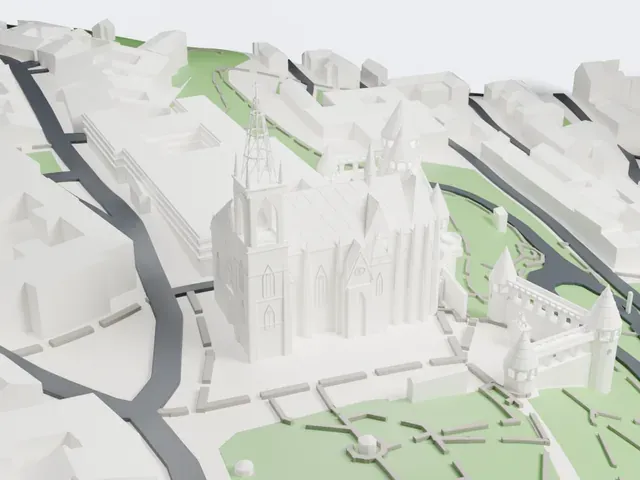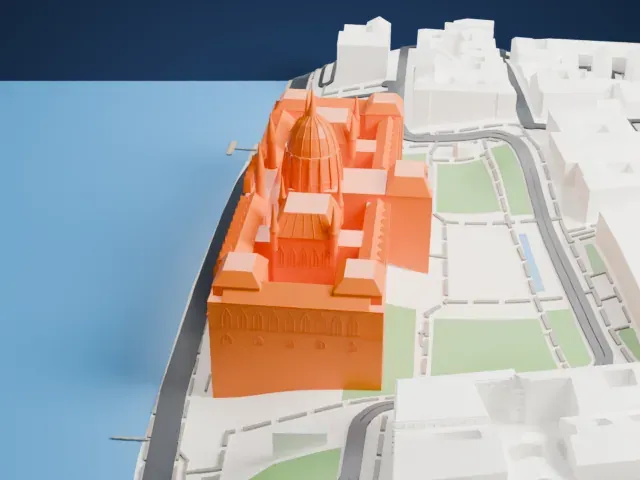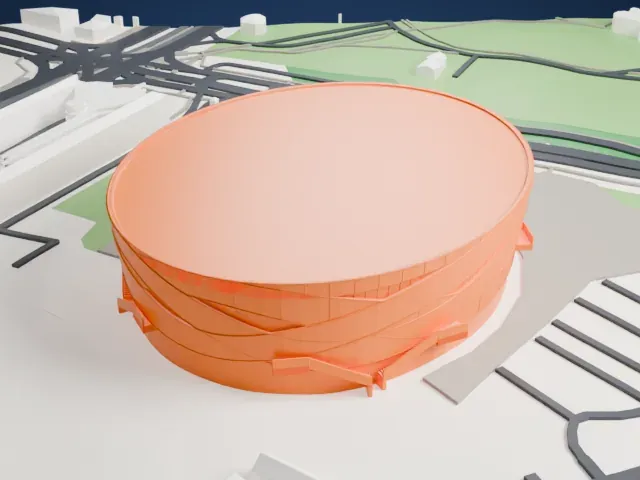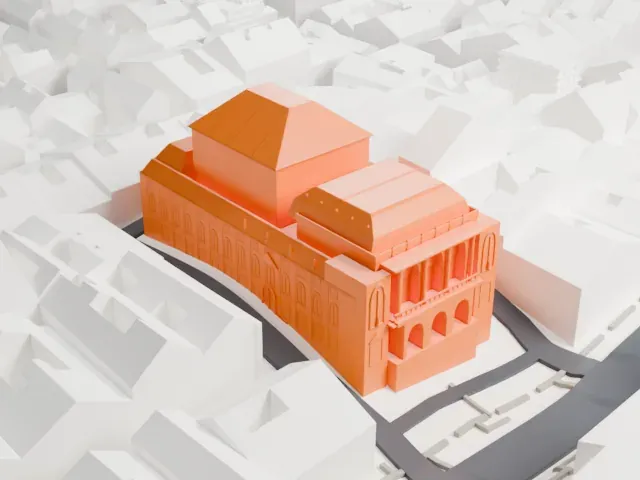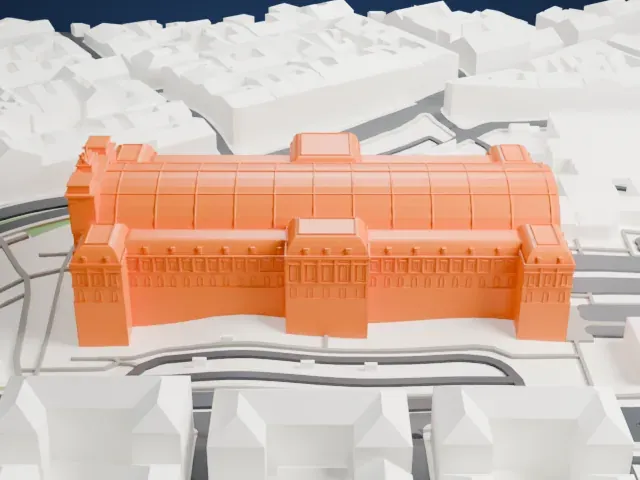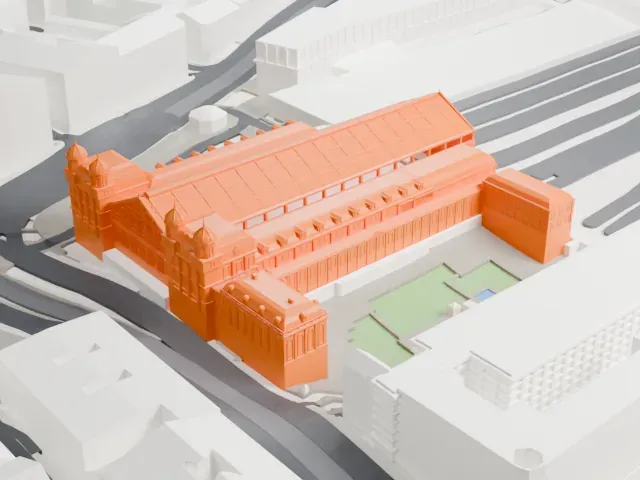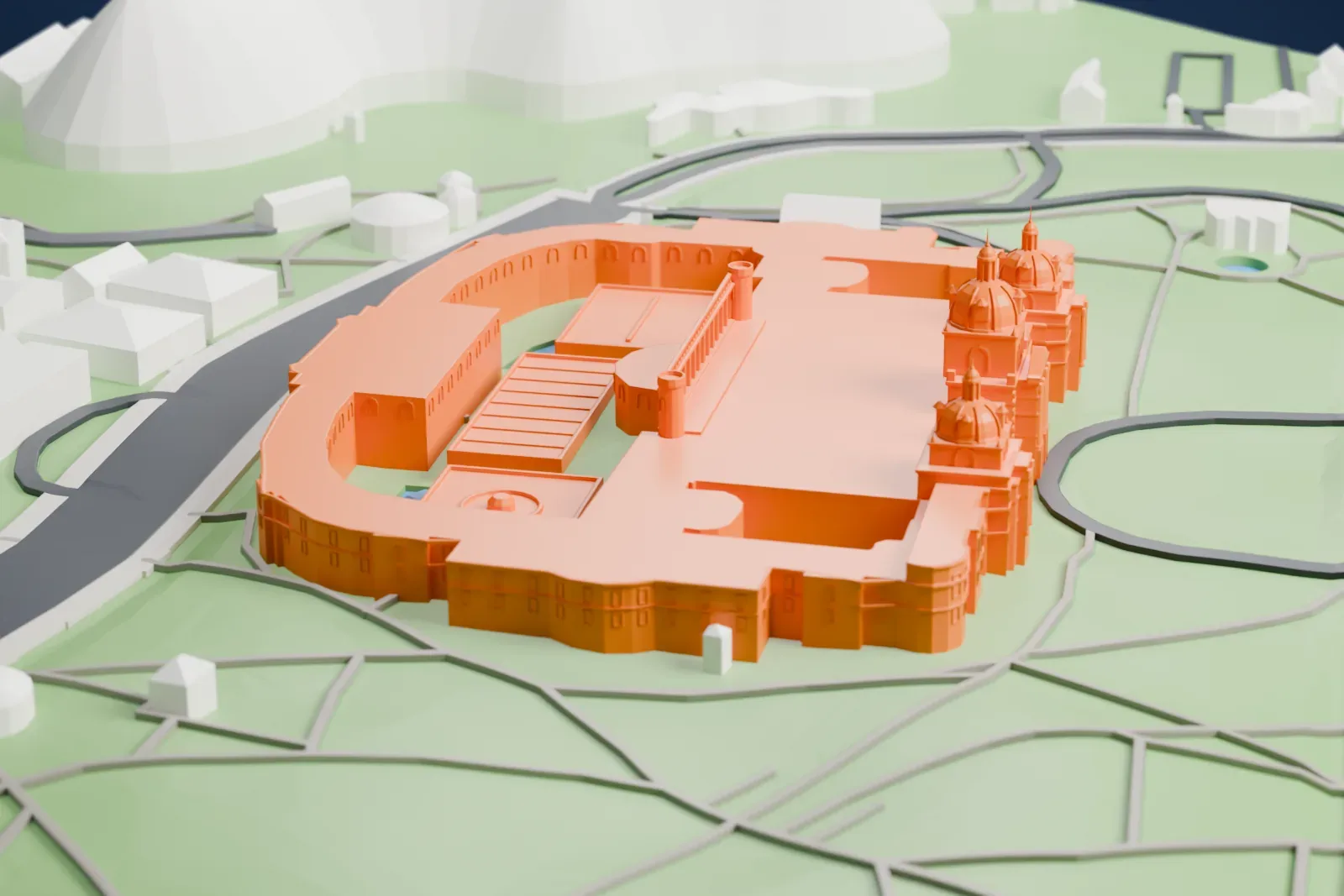
Széchenyi Thermal Bath in 3D
Széchenyi Thermal Bath appears in city models you make here; its design may still be protected, so it isn't offered as a separate download.
-
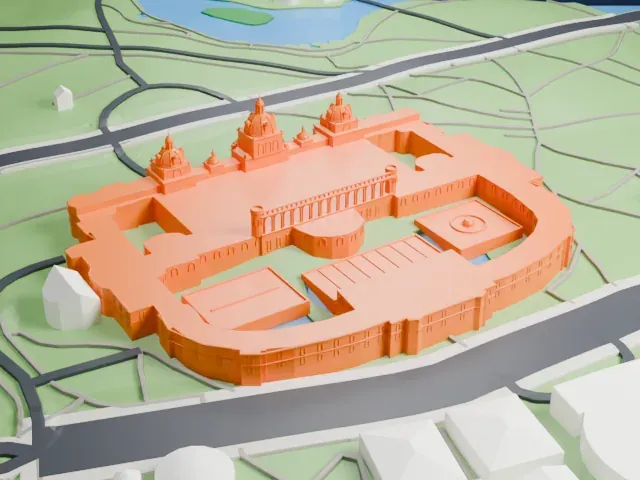 North
-
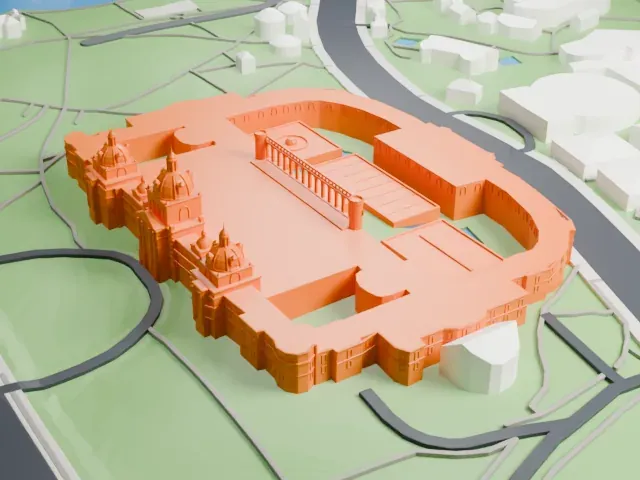 East
-
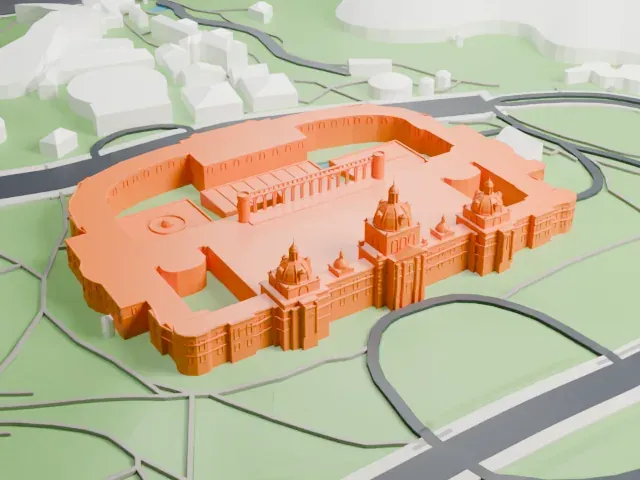 South
-
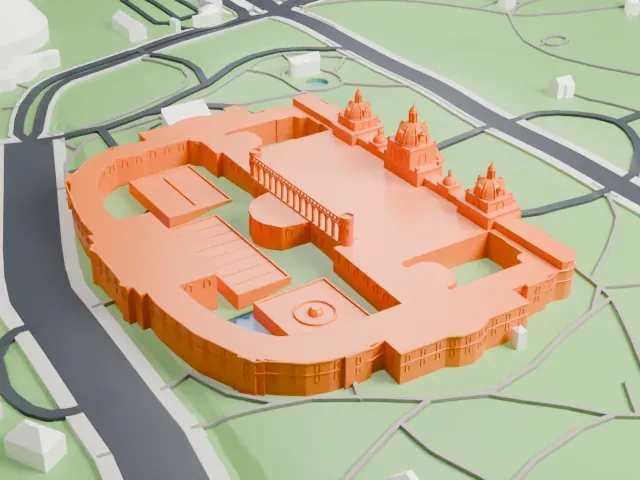 West
Copyright notice
The design of Széchenyi Thermal Bath may still be protected by copyright. It appears in the city models you make here, but it is not offered as a separate model.
- On a 160 mm print
- 12 mm
- Scale
- 1:3,750
12 mm tall on a 160 mm print
Make this print opens the generator on a 600 m square around the landmark. Buildings print at close to true scale, so the landmark grows with the print size.
- Domes and towers on the entrance
One end of the building carries several small domes and tower tops. Print friendly adapts these thin tips to the print scale; Full detail keeps them on a larger print.
- Long arcaded walls
The long outer walls are lined with small arches and columns. A larger print size and a 0.12-0.16 mm layer height help keep them distinct.
- One piece with the ground
Széchenyi Thermal Bath is joined to the ground in the exported file, and the four-side check found no floating parts, so nothing needs gluing.
- Pick the detail for your nozzle
In the Buildings settings, set Landmark detail to Print friendly to adapt thin parts and small details to the print scale. Full detail keeps every modeled feature, for larger prints or a finer nozzle.
- Colors
Buildings, roads, water and ground arrive as separate filament slots in the 3MF. Széchenyi Thermal Bath takes the building color.
- File format
You get a 3MF for Bambu Studio, OrcaSlicer or PrusaSlicer. Any of them can save it as STL if you need one.
About Széchenyi Thermal Bath
Budapest's Széchenyi Medicinal Bath is among Europe's biggest spa complexes. Its water comes from two thermal springs, at 74 °C (165 °F) and 77 °C (171 °F). The mining engineer Vilmos Zsigmondy drilled the first well in City Park between 1868 and 1878, reaching water at 74.5 °C (166.1 °F) from a depth of 970 meters (3,180 ft). A small Artesian bath was working at that well by 1881.
Győző Czigler designed the Neo-Baroque bath in City Park. Czigler died in 1905; work began four years later, in 1909, run by his colleagues Ede Dvorák and Kálmán Gerster. The bath opened in June 1913. Planners had first called it the Artesian spa, but it was named Széchenyi bath after István Széchenyi. Building the pools cost around 3.9 million Austro-Hungarian korona, and the complex covered 6,220 square meters (67,000 sq ft).
The city decided in 1924 to enlarge the bath, and the design contest drew 35 entries, won by Imre Francsek Jr. His extension was completed in 1927 and added an outdoor section as well as public baths for men and women. In 1938 a second thermal spring was found, at 77 °C (171 °F) and 1,256 meters (4,121 ft) deep; it delivers 6,000,000 liters of hot water a day (1,600,000 US gal). The complex holds 3 outdoor and 15 indoor pools, and a complete renovation ran from 1999 to 2009.
About this model
Széchenyi Thermal Bath is one of more than 6,500 landmark models in Mini Skyline. They are made with AI, and each one is checked in its real surroundings before release. Each model is written as code from public descriptions, plans, photographs and aerial views used only as references; no image or third-party model is copied into it. Everything around it is built from OpenStreetMap and Overture map data. Rights in the building itself, its name and any brands on it are not granted by Mini Skyline; clear them separately before you sell prints. If you would rather print the shape from map data, turn off Landmark models in the Buildings settings.
Mini Skyline is not affiliated with, or endorsed by, the owners of this building or its names and marks.
Same skyline